Long ago, at the foot of Geumgangsan, the Diamond Mountains, there lived a young woodcutter and his old mother. They were poor, but they were kind to each other. Every day he climbed into the forest with his axe and his A-frame carrier, and every evening he came home with a load of firewood on his back and sat down to supper with her in their little thatched house.
One afternoon he was chopping branches in a quiet valley when something came crashing through the undergrowth. A deer burst out of the trees, its sides heaving, its eyes wide with fear. “Please,” it gasped, “a hunter is chasing me. Hide me, or I’ll be killed.” The woodcutter didn’t stop to wonder at a talking deer. He pulled aside the pile of brushwood he had cut, let the deer crouch underneath and heaped the branches back over it.
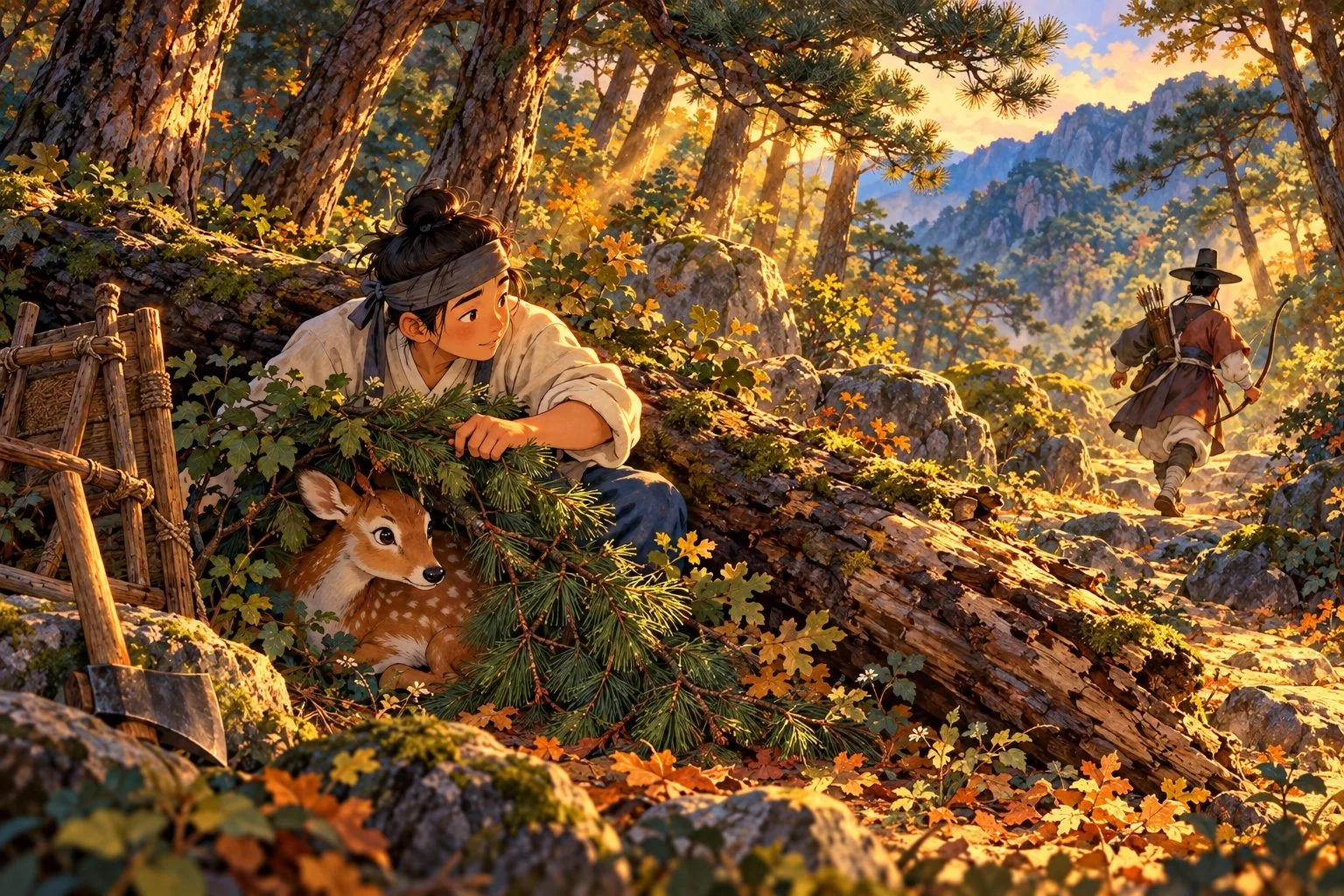
A moment later the hunter came running up with his bow. “Did you see a deer come this way?” he demanded. The woodcutter pointed across the valley. “That way,” he said. “It went over the ridge.” The hunter dashed off, and his footsteps faded into the distance.
The deer crept out from the brushwood and bowed its head. “You saved my life,” it said. “Let me give you something in return. I know you have no wife. Listen carefully. At the top of this mountain there is a pool. On the night of the full moon, the seonnyeo, the maidens of heaven, come down to bathe in it. Hide the feathered robe of one of them, and she will not be able to fly home, and she will stay with you as your wife.” It looked at him gravely. “But remember this. Never show her the robe until you have three children together, no matter how she begs. Three, not fewer.”
The woodcutter walked home that evening in a daze, turning the deer’s words over and over. He did not tell his mother. He was half afraid that if he said it out loud, it would turn out to have been a dream. But that night, and every night until the moon was full, he lay awake looking at the sky.
On the night of the full moon, the woodcutter climbed to the top of the mountain and hid behind a rock. Soon the air began to shimmer, and down through the moonlight came a group of maidens, their robes shining like feathers. They laid the robes on the rocks beside the pool and slipped into the water, laughing and splashing. The woodcutter crept out, took the nearest robe, folded it small and hid it inside his jacket.
Back behind his rock, his heart was pounding so hard he was sure they would hear it. The robe against his chest weighed almost nothing. It felt cool and soft, like a handful of cloud, and it smelled faintly of rain. He crouched there in the dark and did not dare to breathe.
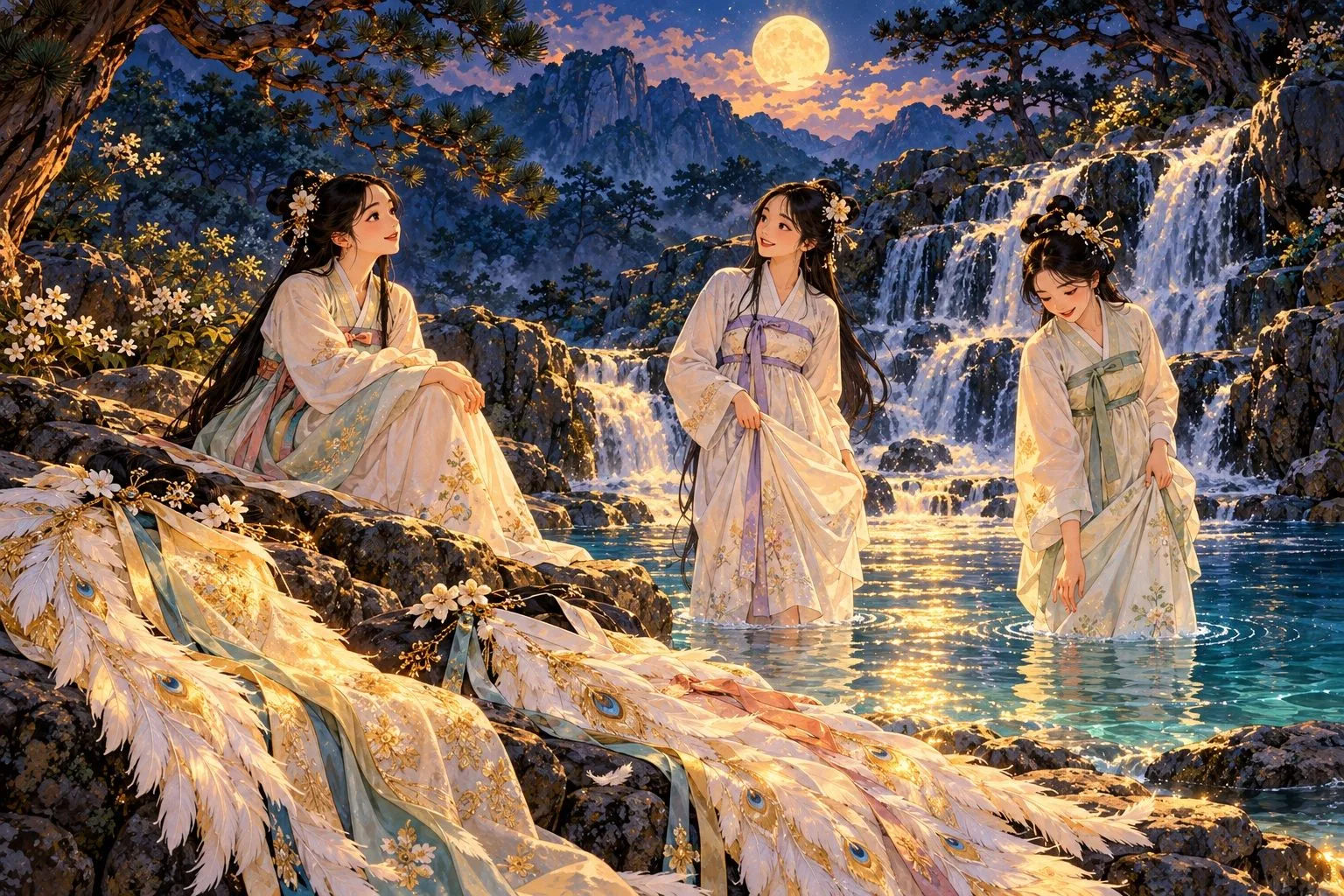
When the night began to pale, the maidens climbed out, put on their robes and rose one by one into the sky. The youngest searched and searched among the rocks, but her robe was gone. She watched her sisters disappear into the clouds, and then she sat down on the cold stone and cried. The woodcutter stepped out from behind the rock, wrapped his own coat around her shoulders and took her home. In time, she became his wife.
They had a son, and then a daughter. The house was full of noise and laughter, and the woodcutter thought he had never been so happy. But sometimes, in the evenings, he would find his wife standing in the yard, looking up at the sky with a face he couldn’t read.
The fairy learned to cook rice over the fire and to weave cloth on the old loom, and the woodcutter’s mother loved her like a daughter. The neighbours said they had never seen such a beautiful bride, nor one so gentle. The woodcutter kept her robe hidden at the bottom of a chest under a pile of old clothes, and every so often, when no one was looking, he checked that it was still there.
One night she turned to him and said softly, “We have two children now, and I’m happy here. I would only like to see my robe again, just once, to remember where I came from.” The woodcutter thought of the deer’s warning. But two children, surely, would be enough to keep her. He went to his hiding place and brought out the robe.
The moment it touched her shoulders, she began to rise. She caught up a child under each arm, and before he could reach her she had floated up through the roof and into the night, growing smaller and smaller until she vanished among the stars.
The woodcutter was beside himself. For days he wandered the mountain calling for the deer, and at last it appeared in front of him. “I told you three,” it said sadly. “With three children, she could not have carried them all. But there is still a way. Since that night, heaven no longer lets the maidens come down to bathe. Instead, they lower a great bucket on a rope to draw water from the pool. Go there, empty the bucket, climb inside, and it will carry you up.”
The woodcutter did exactly as the deer said. When the bucket came down through the moonlight, he tipped out the water, climbed in and held on, and it rose and rose, past the treetops and the clouds, all the way into heaven. There he found his wife and his children, and they wept with joy to see him. For a time, the family was whole again, and he lived happily in the sky.
Heaven was nothing like the world below. The houses were built of light, the fields never needed ploughing, and nobody ever grew cold or hungry or tired. His children grew tall and strong in the clear air, and his wife was happier than he had ever seen her. The woodcutter, who had chopped wood every day of his life, found that he had nothing at all to do.
But he could not stop thinking of his old mother, alone in the little house at the foot of the mountain. Who was cooking for her? Who was bringing in her firewood? At last his wife could not bear his sadness any longer. She led out a dragon-horse that could fly between heaven and earth. “Ride down and see her,” she said. “But listen to me. Whatever happens, do not get off this horse. If your feet touch the ground, you can never come back to us.”
The horse carried him down through the clouds to his mother’s door. She cried out when she saw him and held his hands and wouldn’t let go. She had made pumpkin porridge, his favourite, and she begged him to eat a bowl before he left. He didn’t dismount. He leaned down from the saddle and took the steaming bowl in both hands. But as he lifted it, hot porridge slopped over the rim and splashed onto the horse’s back.
The horse screamed and reared. The woodcutter tumbled from the saddle and hit the ground, and before he could scramble up, the horse had leapt into the sky and was gone.
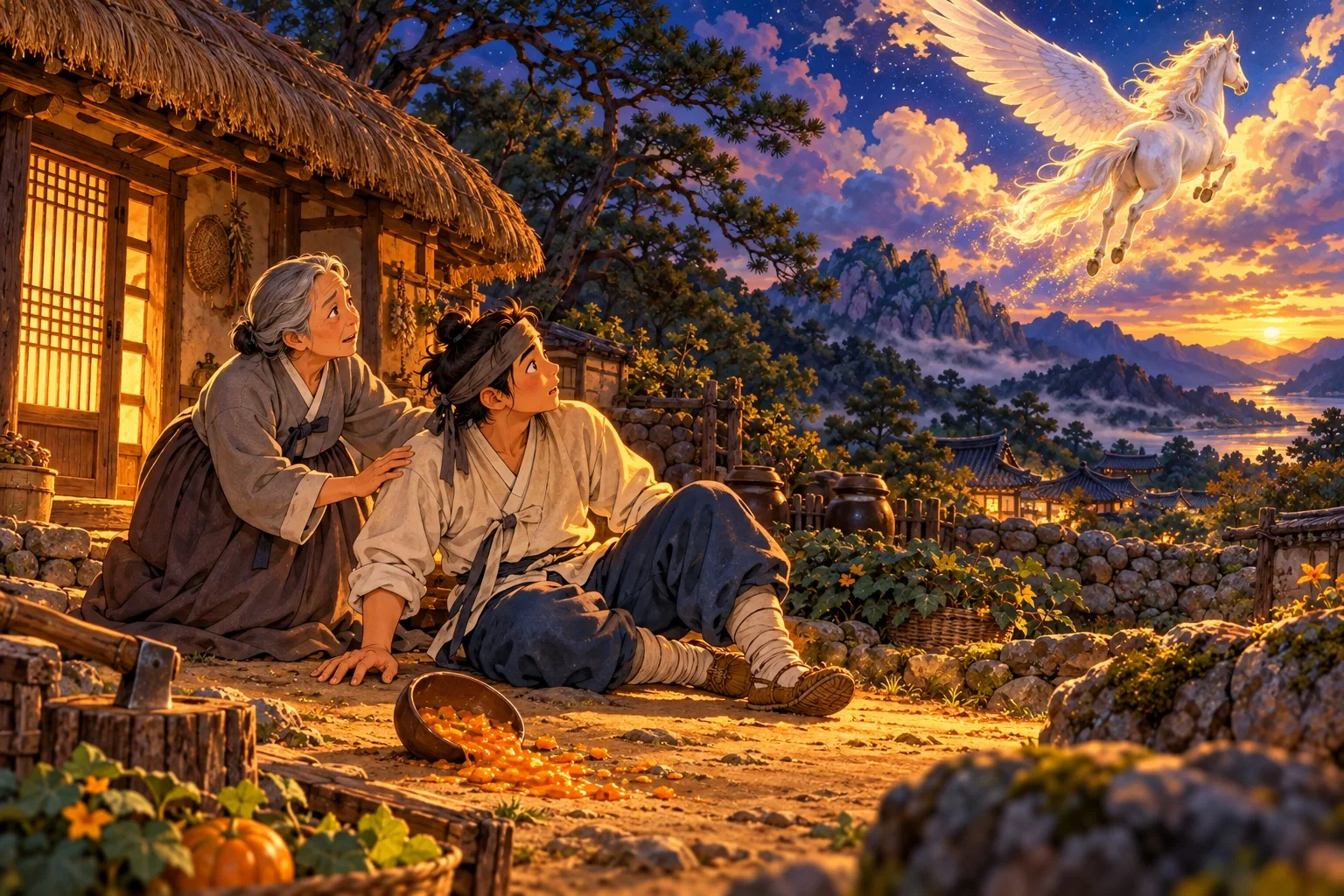
He never saw his wife or his children again. Every day for the rest of his life he stood in the yard and looked up at the sky, calling to them. When at last he died, the storytellers say, he became a rooster. And that is why, every morning, the rooster climbs onto the roof, stretches his neck toward heaven and cries out, still calling for the family he lost.
Other endings
Not every teller is so hard on the woodcutter. In some villages the story ends the moment the fairy flies away, a short, sharp lesson about a broken promise. In others the woodcutter reaches heaven and stays there for good, sometimes only after his wife’s father tests him with a series of impossible tasks, which he passes with her secret help. There are even tellings where the fairy cuts the rope as he climbs. The rooster ending is the best known, partly because it does what so many folktales do: it explains something you can still see and hear today.
Talk about it
Why do you think the deer insisted on three children and not two? Was the fairy wrong to leave? Is this really a love story? And did the woodcutter’s ending feel fair to you?
Words to know
Seonnyeo (선녀) means a heavenly maiden or fairy. Namukkun (나무꾼) means woodcutter. Nalgaeot (날개옷), “wing clothes”, is the fairy’s feathered robe. Durebak (두레박) is a well bucket on a rope. Yongma (용마) is a dragon-horse, a magical horse that can fly.
Where this story comes from
The Woodcutter and the Fairy is one of the most widely told folktales in Korea, and is also known as the Fairy of Geumgangsan (금강산 선녀 설화). It first appeared in print in 1898, in a Russian collection of Korean tales by the writer N. G. Garin-Mikhailovsky, and was recorded many more times in the early twentieth century. Folklorists sort the many Korean tellings by how they end. In the shortest, the fairy flies home and the story stops. In others, the woodcutter rides the bucket up to heaven and lives there happily, sometimes only after passing a series of trials set by his wife's heavenly father. The ending told here, in which he returns to earth, falls from the horse and becomes a rooster, is the one most Koreans grow up with. In some places the hot dish is red-bean porridge rather than pumpkin, and in some the helpful animal is a roe deer.
The tale belongs to a worldwide family that scholars call swan-maiden stories, in which a man hides the feathered robe or skin of a heavenly or animal woman so that she cannot leave. Close relatives are told in China, in Japan as the hagoromo legends, and across Mongolia, Siberia, Southeast Asia and Europe. In Korea today it lives on in songs, webtoons, theatre and musicals, and in classroom debates about its opening.
What it means
The whole story turns on a promise. The deer says three children, the woodcutter decides that two will do, and everything comes apart. On one level it is an old warning about patience and keeping your word. But it also gives the fairy a will of her own. She never stops looking at the sky, and the moment she has a choice, she makes it. Many modern Korean readers now begin with that point. A hero who wins a wife by hiding her clothes is not an obvious romantic lead, and picture books and classrooms increasingly ask whether this is really a love story, or a story about a woman kept somewhere she never chose to be.
The ending moves the sadness onto the woodcutter himself. He wins his family back and then loses them for good, because he cannot refuse his mother's porridge. Korean readers often see this as a story about divided loyalty, about being pulled between the family you were born into and the family you made, and about how one small kindness, accepted at the wrong moment, can cost everything. The rooster crying at the sky every morning turns that longing into something you can still hear.
Sources & further reading
Retold from the common Korean telling with the rooster ending, following the plot, ending types and early records summarised in the Encyclopedia of Korean Culture (Academy of Korean Studies), entry "나무꾼과 선녀", and the National Folk Museum of Korea's entry "선녀와 나무꾼". It is an English adaptation, not a translation.
- Encyclopedia of Korean Culture · 나무꾼과 선녀 ↗
- National Folk Museum of Korea · Encyclopedia of Korean Folklore and Traditional Culture · 선녀와 나무꾼 ↗
Illustrations are imaginative interpretations, not historical records. Read our editorial policy.