Once upon a time, beside a fast little stream at the foot of a hill, there lived a mother frog and her only son, a small green tree frog with bright gold eyes and a very loud voice. She loved him more than anything in the world. The trouble was that he had decided, almost as soon as he could hop, that he would never do a single thing she asked.
If she said, “Go and play up on the hill today, the stream is running high,” he went straight down to the stream and splashed about in the shallows. If she said, “Stay by the water where it’s cool,” he spent the whole hot afternoon on the dusty hilltop. If she told him to come home before dark, he stayed out until the moon was up. If she told him he could stay out late, he was home before supper, sitting in the corner with his arms folded.
It went on like that in everything. When she asked him to sit still, he bounced off the walls. When she asked him to eat his flies, he wanted worms. When the other frogs gathered in the evening to sing, his mother would say, “Now sing nicely, like a proper frog. Gaegul gaegul.” And he would puff out his throat and sing, at the top of his voice, “Gulgae! Gulgae!” Then he would look at her sideways to see how cross she was.
Once she warned him not to go near the big pond on the other side of the hill, where the herons fished. Off he went that very afternoon, and came home at dusk with half his toes nearly nipped off, shaking with fright, and still refused to admit she had been right. “I wanted to go there anyway,” he croaked, dripping on the floor. “I was going to go there whatever you said.”
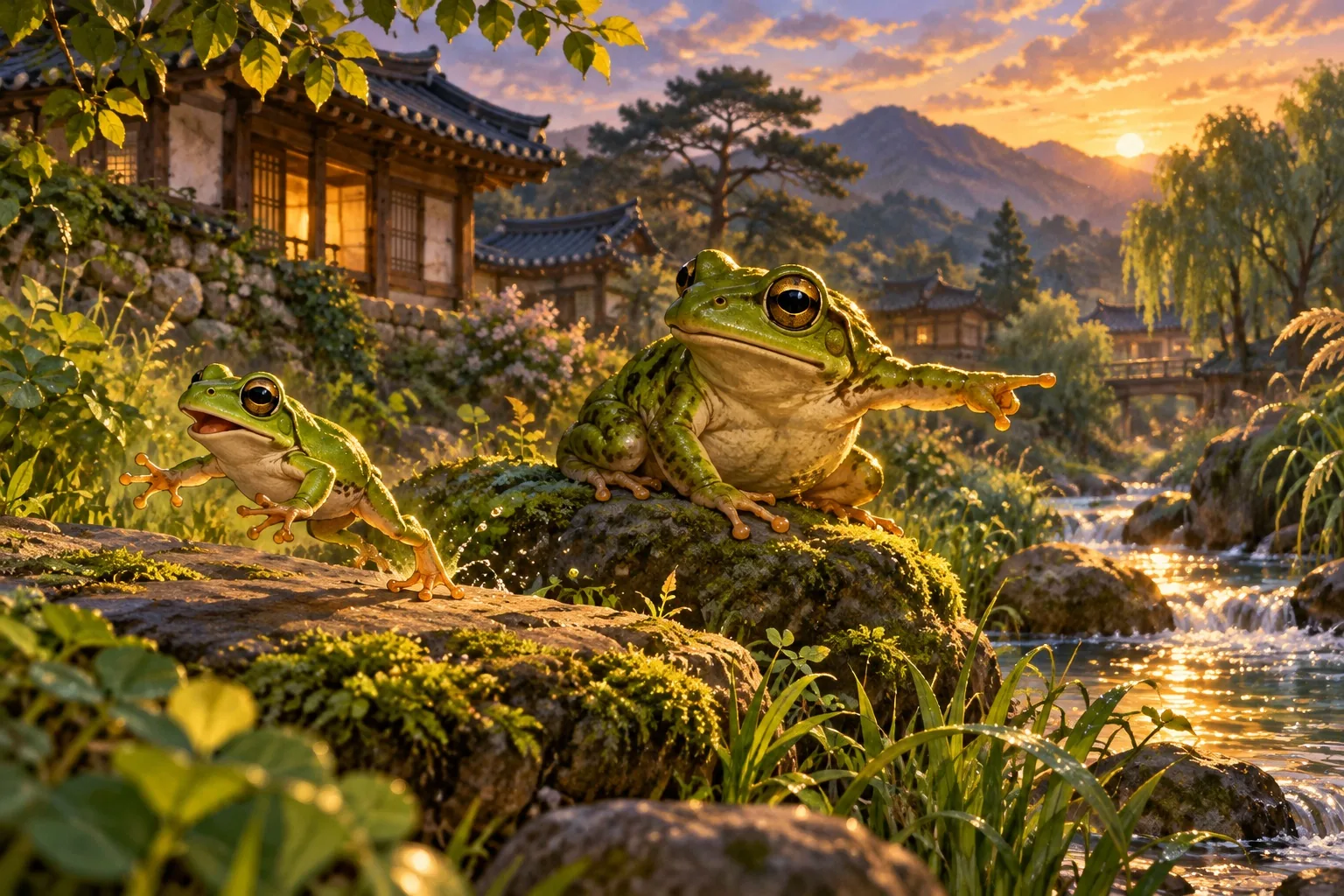
The neighbours thought it was funny at first. Then they thought it was rude. In the end they simply shook their heads and called him the backwards frog. His mother stopped laughing a long time before they did. She lay awake at night wondering what would happen to him when she wasn’t there to keep him out of trouble. She tried being gentle and she tried being strict. She tried explaining and she tried pleading. Nothing worked. Every word she said seemed to push him the other way.
Sometimes she sat on her lily pad in the evening, watching the sun go down over the hill, and wondered aloud what she had done wrong. Other mothers’ children came when they were called. Other mothers’ children sang gaegul gaegul like everyone else. She could not understand where her son’s stubbornness had come from, and it hurt her more than she ever let him see.
Years of worry wore her down, and one autumn she fell ill. She grew weaker by the day, and soon she understood that she would not get better. That frightened her less than the thought of her son alone, and there was one more thing on her mind. She did not want to be buried by the stream. Every summer the rains came and the water rose over its banks, and she could not bear the thought of her grave being washed away. She wanted to lie up on the sunny hillside, where the ground was dry and the view was wide.
But she knew her son. If she asked to be buried on the hill, he would bury her by the water, just to be contrary, the way he always did. So she called him to her bed and took his little hand, and she said the opposite of what she meant.
“When I die,” she told him, “don’t bury me up on the hill. Bury me down by the stream.”
Then she closed her eyes. A few days later, she died.
In those last days, her son did not leave her side. He brought her water in a curled leaf, and the softest moss for her pillow, and he did not argue with her once. She noticed, and it made her smile, though it also made her sadder than anything had for a long time.
The little frog sat beside her for a long time without moving. He kept waiting for her to open her eyes and tell him off. She didn’t. And slowly, for the first time in his life, he understood what he had done. Every gulgae he had sung, every walk to the wrong place, every time he had come home late just to watch her face fall, came back to him all at once. He had wasted every chance to make her happy, and now there would never be another.
“I never listened to you,” he sobbed. “Not once. But I will now. I’ll do exactly what you asked. I promise.”
So he did. With his own small hands he dug her grave on the bank of the stream, just as she had told him to, and laid her in it, and patted the earth down into a neat little mound. He sat beside it all through the autumn and the long winter, and when spring came he planted wildflowers on it.
It was hard work for a small frog. The earth by the stream was soft and wet, and his hands were tiny, and it took him all day. Every so often he stopped and looked up at the dry, sunny hillside, and something tugged at the back of his mind. But he pushed the thought away. This time, for once, he was going to do exactly what she had said.
Then summer arrived, and with it the monsoon rains. Dark clouds piled up over the hill. The first drops fell, then more, and then the sky opened. The stream that had been a friendly trickle turned brown and fast and loud. It climbed up its banks, inch by inch, toward his mother’s grave.
The little frog scrambled up onto the mound and spread his arms wide over it, as if he could hold the earth together with his own small body. Rain hammered on his back. Sticks and leaves swept past in the brown water. The wildflowers he had planted bent flat under the weight of the downpour, and the edge of the mound began to crumble, one wet clump at a time.
The little frog sat on the mound in the pouring rain and watched the water rise. He couldn’t stop it, and he couldn’t move her. All he could do was cry. “Please don’t wash her away,” he wailed at the river. “Please, please don’t take her away!” He cried all through the storm, his voice ringing out over the noise of the water, and he did not stop until the rain did.
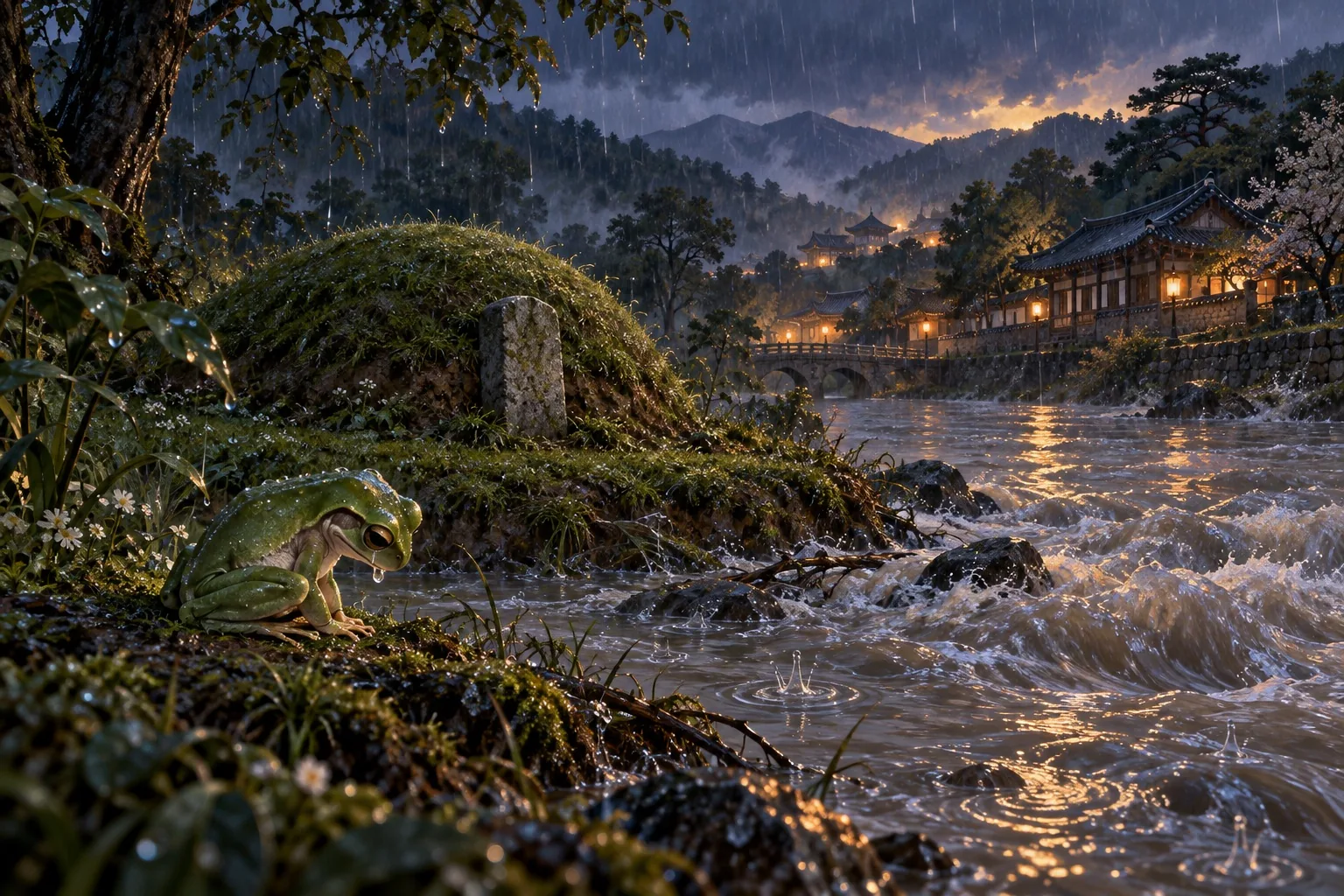
The next time the clouds gathered, he was there again. And the time after that. He never forgot, and neither did his children, or their children after them.
Each time the sky darkened, he felt it before anyone else did, a heaviness in the air and a smell of wet earth, and he would hurry down to the stream and take his place on the little mound and begin to call.
That, Korean grandparents say, is why green tree frogs still start calling the moment rain is on the way, and why they call so loudly while it falls. They are worrying about their mothers’ graves down by the water, and wishing, far too late, that they had listened.
Why frogs really sing in the rain
Real frogs do get livelier when rain is on the way, and the National Folk Museum of Korea’s encyclopedia entry on this tale gives the practical reason. Frogs cannot breathe fully through their lungs alone and also breathe through their skin, which works best when it is moist, so the damp air before a shower leaves them more active and vocal. People in old Korea noticed the pattern long before anyone could explain it, and the story gave the sound a meaning: not a cheerful song but a little frog crying for his mother.
Talk about it
Was the mother right to trick her son by saying the opposite? Why do you think the frog decided to obey just this once? And is being a bit of a cheonggaeguri, someone who does things differently, always a bad thing?
Words to know
Cheonggaeguri (청개구리) is a green tree frog, and also what Koreans call a child who always does the opposite. Gaegul gaegul (개굴개굴) is the sound a Korean frog makes, like “ribbit”. Hyo (효) is the duty of children to respect and care for their parents. Pungsu (풍수) is the Korean tradition of reading land and water to choose good sites for homes and graves.
Where this story comes from
The Green Frog is told all over Korea, and the folklore collections class it as an origin tale: a story that explains something in nature, here why tree frogs call so loudly when rain is on the way. Recorded tellings appear in the Compendium of Korean Oral Literature (한국구비문학대계) and in Im Seok-jae's Korean Oral Tales (한국구전설화), and the outline barely changes from one village to the next.
The idea of a contrary child who obeys only once, at the worst possible moment, is much older than any single Korean telling. Chinese collections from the Tang and Song dynasties, including the Taiping Guangji (太平廣記), contain stories of an unfilial son who buries a parent in exactly the wrong place, and in Japan similar tales are usually told about birds, such as doves or owls, to explain why they cry. Korea has its own human version too. In one legend, the rebel general Yi Gwal always disobeyed his father, who was secretly half dragon and asked to be buried upright, expecting his son to bury him upside down so he could rise to the sky as a dragon. Yi Gwal, full of regret, obeyed for once, his father never became a dragon, and his rebellion later failed.
The word itself has passed into everyday Korean. A child who always does the opposite is called a cheonggaeguri, and a contrary streak is a "green frog's heart" (청개구리 심보).
What it means
The usual lesson, and the one small Korean children hear, is to listen to your parents while you still can. That's a fair reading, but it isn't the whole story. The mother is clever too. She knows her son so well that she gives her last instruction backwards, expecting him to disobey one more time. What she never imagines is that grief might change him. The tragedy comes from two people who love each other each guessing wrong about the other at the very last moment.
It matters what she is asking for. In old Korea the choice of a grave site was a serious matter, tied to pungsu (풍수), the Korean tradition of reading landscape for good fortune, and to hyo (효), the duty children owe their parents. A grave on a dry, sunny slope was a blessing. A grave on a riverbank, where every flood could wash it away, was close to the worst place imaginable. So when the little frog finally does what he is told, he gets it exactly, painfully wrong.
It's also unusual among folktales in not punishing its naughty character in the usual way. Nobody beats the frog or eats him. He just has to live with what happened, and remember it every time it rains. Interestingly, a modern Korean encyclopedia entry on the tale notes that attitudes are shifting, and that a little green-frog thinking, doing things differently from everyone else, is now sometimes seen as a strength.
Sources & further reading
Retold from the common Korean telling summarised by Kim Gyeong-hui in the National Folk Museum of Korea's Encyclopedia of Korean Folklore and Traditional Culture, entry "청개구리 이야기", which cites the Compendium of Korean Oral Literature (1-7 and 9-3) and Im Seok-jae's Korean Oral Tales, and notes the Chinese parallels and the Yi Gwal variant. It is an English adaptation, not a translation.
- National Folk Museum of Korea · Encyclopedia of Korean Folklore and Traditional Culture · 청개구리 이야기 ↗
Illustrations are imaginative interpretations, not historical records. Read our editorial policy.