Long ago, when tigers still smoked pipes, a widow lived with her son and daughter in a small house at the foot of the mountains. She earned their food by working in bigger houses in the next village, and one day she spent from dawn till dusk helping to prepare a feast. When the work was done, the family she worked for filled her basket with rice cakes to take home. She set off over the hills as the sun went down, thinking about how happy the children would be.
Before she left that morning, she had told them what she always told them. “Bar the door and don’t open it to anyone, not until you hear my voice. I’ll be home by dark.” The brother had nodded seriously. He was the older one, and he took it as his job to look after his little sister. The sister had already been thinking about rice cakes.
At the top of the first hill, a tiger stepped out onto the path. “Give me a rice cake and I won’t eat you,” it said. (떡 하나 주면 안 잡아먹지, tteok hana jumyeon an jabameokji, is still one of the most quoted lines in Korean.) The mother handed over a rice cake, and the tiger let her pass. At the top of the next hill, the same tiger was waiting with the same words, and again she gave it a rice cake. This happened hill after hill until the basket was empty. At the last hill the tiger asked once more, she had nothing left to give, and the tiger ate her.
She hurried on, her heart pounding, telling herself it was over. The path wound down into a dark valley and up again, and the wind hissed in the pine trees, and the basket on her head felt lighter than it should.
Some tellers make it worse. When the rice cakes run out, the tiger asks for her arm, and then her other arm, and then her legs, and she gives each one, still trying to get home. Others hurry past this part, because everyone listening already knows how it ends.
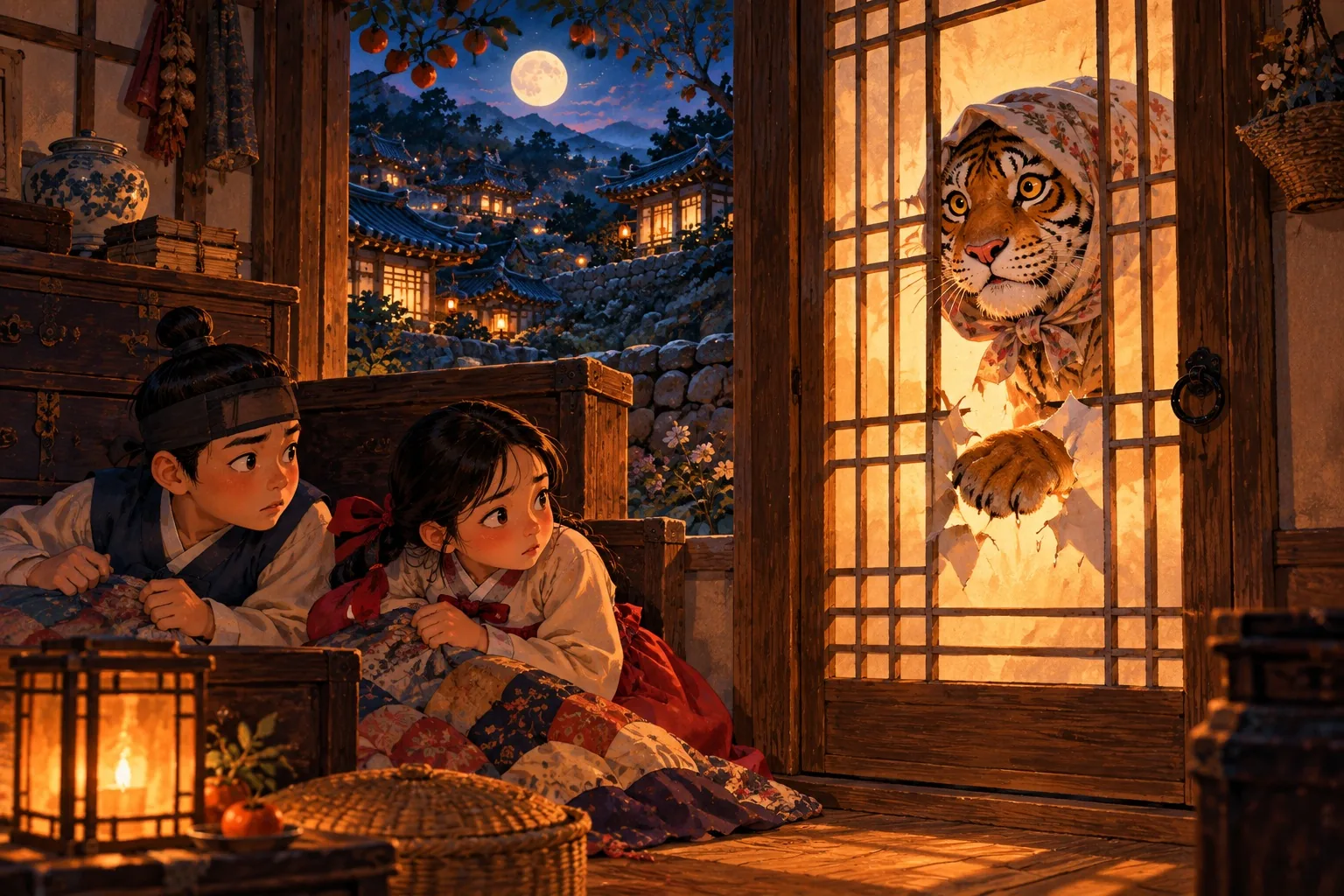
Then the tiger had an idea. It put on the mother’s clothes and headscarf and walked down to the little house, where the children had barred the door against the dark. “Open up, it’s your mother,” it called. The voice sounded rough and strange, so the children asked to see her hand first. The tiger pushed a hairy paw through a hole in the paper door. “Our mother’s hand isn’t hairy,” said the brother. The tiger explained that it had been working with rough straw all day, and when the children still hesitated, it said it was cold and tired and its hands were chapped from work. Bit by bit, the children were talked into opening the door.
“Your voice sounds strange,” the sister said through the door.
“I’ve been shouting at the market all day,” said the tiger. “It’s made me hoarse. Come on, open up. Your poor mother is freezing out here.”
The children looked at each other. It was dark outside, and cold, and they missed their mother terribly. And so, at last, the brother slid back the bar.
Then, as the tiger stepped over the threshold and into the lamplight, the sister whispered, “Mother, why are your eyes so yellow?”
“I’ve been crying all the way home because I missed you,” said the tiger smoothly, and it turned its face away from the lamp and sat down heavily in the darkest corner of the room.
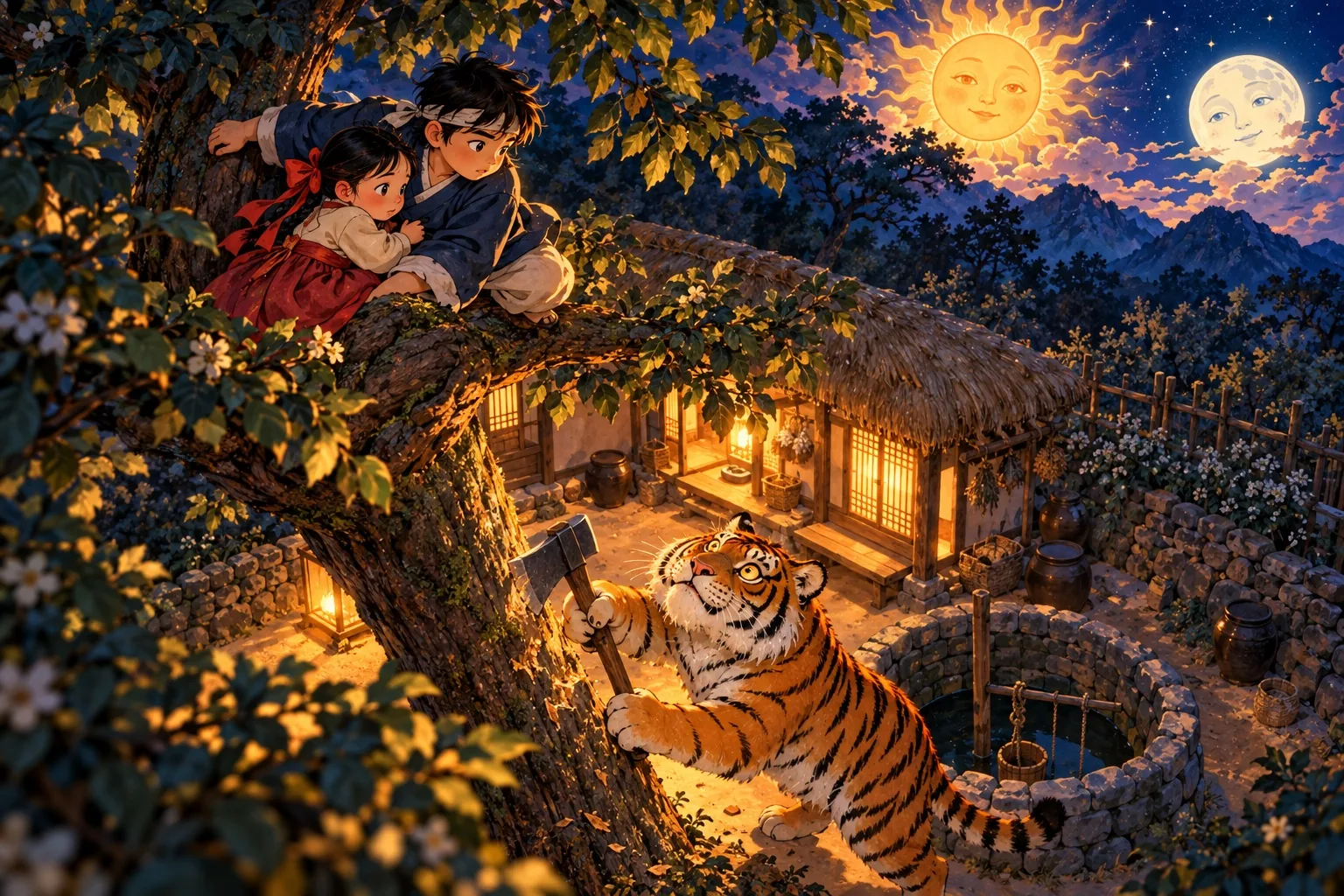
Once the tiger was inside, the brother saw a striped tail poking out from under the skirt. He took his sister’s hand, whispered that they needed to go to the toilet, and slipped out the back to the well, where a tall tree grew. They climbed as high as they could. When the tiger came looking, it saw their faces reflected in the water of the well and leaned over, trying to scoop them out. Then the little sister laughed, and the tiger looked up.
His heart nearly stopped. He did not scream, and he did not let his sister see his face. He only squeezed her hand very hard, so hard that she looked up at him in surprise, and she saw in his eyes that something was terribly wrong.
The children clung to the branches, hardly daring to breathe, while the tiger prowled round and round the well, muttering and growling. They could see its eyes shining in the dark. Then the tiger spotted their reflections in the dark water, two little faces looking up from the bottom of the well, and it bent over the edge, swiping at the water with its great paw. It looked so silly, splashing away at nothing, that the little sister could not help herself.
“How did you get all the way up there?” it asked. The brother was quick. “We rubbed sesame oil on the trunk,” he said. The tiger fetched the oil from the kitchen, spread it on the bark and slid straight back down, again and again. But the little sister, who was too young to know better, giggled and said, “Silly, you should cut steps with an axe.” The tiger fetched an axe, chopped footholds into the trunk and began to climb.
Chop. Chop. Chop. Step by step it came up the tree, its eyes fixed on them, its claws scraping the bark. The brother pulled his sister higher, onto the very thinnest branches at the top, until they swayed and creaked under them. There was nowhere left to climb.
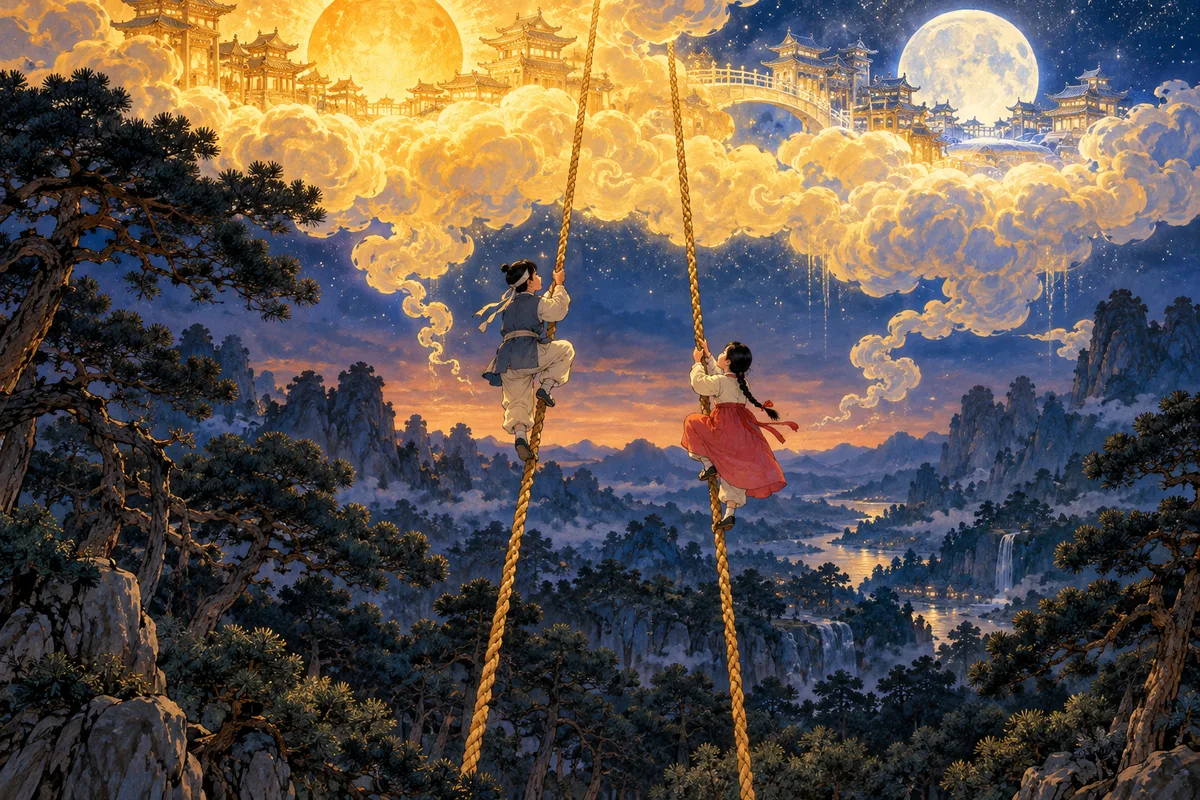
With nowhere left to go, the children looked up at the sky and prayed. “Heaven, if you mean to save us, send down a strong new rope. If you mean for us to die, send down a rotten one.” A strong rope came down from the sky, and the brother and sister climbed it up into the heavens.
For a moment nothing happened. Then, high above, something gleamed in the starlight, and a rope came snaking down out of the darkness, thick and new and strong, and stopped just above their heads. The brother lifted his sister onto it and climbed up after her. Up and up they went, above the tree, above the house, above the dark mountains, until the earth below was only a scatter of tiny lights.
The tiger reached the top of the tree, saw what had happened and prayed in the same words. A rope came down for it too, but this one was rotten. Halfway up it snapped, and the tiger fell into a field of sorghum below and died. People say that the red streaks you can still see on sorghum stalks are the tiger’s blood.
The tiger never once wondered why heaven might choose to save two frightened children and not the beast who had eaten their mother.
In heaven, the brother was made the sun and the sister was made the moon. But the sister was afraid of the dark, and she did not want to be alone in the night sky, so the two of them traded places. She became the sun, and because she was shy about everyone staring up at her, she shone so brightly that nobody could look straight at her. People say that is still true today.
The Heavenly Emperor looked down at the two children, brave and frightened and far from home, and gave each of them a job that would keep them in the sky for ever, where no tiger could reach them.
Talk about it
Why did the children open the door even though the voice sounded wrong? Was the little sister’s mistake really her fault? The tiger prays with exactly the same words as the children, so why do you think it gets a rotten rope?
Words to know
Tteok (떡) means rice cake. Onui (오누이) means brother and sister. Dongajul (동아줄) is a thick, strong rope, and susu (수수) is sorghum, a tall grain grown in Korean fields.
Where this story comes from
This is one of the best-known folktales in Korea and has been told in every region of the country. Folklorists have recorded dozens of oral versions, and most of them share the same shape: the rice-cake bargain on the hills, the tiger in disguise, the escape up the tree, the two ropes and the children turning into the sun and the moon. In Korean the story is usually called Hae-wa dal-i doen onui, and children often know the two heroes as Haenim and Dalnim, "Mr Sun" and "Miss Moon".
The details shift depending on who is telling it. Some versions swap which child becomes which in the first place, and some skip the swap entirely. In a few, the tiger falls onto a millet or buckwheat field rather than sorghum. A handful of versions add a baby sibling whom the tiger eats inside the house, which makes the story even darker. The version above follows the most common telling.
What it means
On the surface this is a story about two children escaping a monster, and like many folktales around the world it carries a warning: don't open the door to a stranger, no matter what they say. Readers often notice the similarity to Little Red Riding Hood and to the Grimms' The Wolf and the Seven Young Kids, where a wolf also disguises its voice and paws to get through a door. Stories like this appear across Asia too, with tigers, wolves or ogresses in the villain's role, which suggests that people everywhere worried about the same thing.
The ending turns it into something bigger. Instead of just running home safe, the children are taken up into the sky and become part of how the world works. Korean scholars often read the rope from heaven as a sign that the universe rewards honesty and punishes cruelty, since the tiger copies the children's prayer word for word and still gets the rotten rope. Heaven, the story suggests, can tell who is sincere and who is pretending.
The sister's fear of the dark is also worth noticing. She is the youngest and the one who nearly gets them killed by telling the tiger about the axe, but in the end she becomes the sun, the brightest thing in the sky. It is a kind way to end a frightening story: the smallest, most scared character gets the most powerful job.
Sources & further reading
Retold from the common version recorded in the National Folk Museum of Korea's Encyclopedia of Korean Folk Literature (한국민속문학사전), entry "해와 달이 된 오누이", with regional variants from the Compendium of Korean Oral Literature (한국구비문학대계).
- National Folk Museum of Korea · Encyclopedia of Korean Folk Literature · 해와 달이 된 오누이
- Compendium of Korean Oral Literature (한국구비문학대계) · regional versions
Illustrations are imaginative interpretations, not historical records. Read our editorial policy.