High above the clouds, in the palace of heaven, lived the Heavenly Emperor and his granddaughter Jiknyeo. Of all the maidens of heaven, Jiknyeo was the finest weaver. From morning until night she sat at her loom beside the palace window, and the cloth that flowed from it shimmered like the sky at dawn, pink and gold and pale blue. The clouds that drift over the earth, some said, were woven by her hands.
The Heavenly Emperor loved her more than anything in his kingdom. He loved her skill, and he loved her patience, and he was proud of how hard she worked. But as the years went by, he began to worry that she did nothing but work. She never went walking in the gardens of heaven. She never laughed with the other maidens. She sat at her loom, and wove, and wove.
“She is old enough to marry,” the Emperor said to himself. “A good husband would bring some joy into her life.”
The herdsman across the river
Through the middle of heaven flows a great river, wide and bright and full of stars. People on earth look up at night and call it the Milky Way. On the eastern bank of this River of Stars lived a young herdsman named Gyeonu.
Gyeonu tended the oxen of heaven. He led them out to graze in the meadows at dawn, brought them to drink at the river at noon, and led them home again at sunset. He knew every one of them by name. He was strong and gentle and steady, and no one in heaven had ever known him to leave a task half done.
The Heavenly Emperor watched him for a long time. “He works as hard as my granddaughter,” he thought. “They will understand each other.” So he sent for Gyeonu and offered him Jiknyeo’s hand in marriage.
Gyeonu crossed the River of Stars and came to the palace, and Jiknyeo looked up from her loom and saw him for the first time. Neither of them said very much. But the Emperor, watching, saw his granddaughter smile, and he knew he had chosen well.
Gyeonu stood awkwardly in the doorway with his big farmer’s hands clasped in front of him, and Jiknyeo found that, for the first time in years, she had stopped weaving in the middle of a row.
Too happy to work
Gyeonu and Jiknyeo were married, and they fell more deeply in love than anyone in heaven had ever seen. They walked together along the banks of the River of Stars and watched the light ripple on the water. They talked late into the night, and woke up still talking. They could not bear to be apart even for an hour.
And slowly, without noticing, they forgot everything else.
Jiknyeo’s loom stood silent by the window, gathering dust. The half-woven cloth sagged on its frame. No new cloth came from heaven, and the gods and spirits who needed new robes waited, and waited, and grumbled. On the far bank of the river, Gyeonu’s oxen wandered off untended. They trampled the fields of heaven, broke down the fences, and grew thin and wild.
The newlyweds did not notice. They were too happy to care.
Down on earth, people began to notice too. The seasons slipped out of order. Some said the summer rains came late that year and the autumn came too early, and the old people looked up at the sky and shook their heads, and said that something must be wrong in heaven.
The Heavenly Emperor noticed. At first he said nothing. “They are young,” he told himself. “They will settle down.” Then he sent a servant to remind them of their work. They promised they would start again tomorrow. Tomorrow came, and the loom stayed silent. He warned them himself. They bowed and promised again. And again nothing changed.
At last his patience ran out.
He called them before his throne, and his voice rolled through the palace like thunder.
“I gave you to each other so that you would be happy,” he said. “Not so that you would forget everything else. The heavens are falling into disorder because of you. Since you cannot be together and still do your work, you shall not be together at all.”
He sent Gyeonu back across the River of Stars to the eastern bank, to his oxen. He kept Jiknyeo on the western bank, at her loom. And the wide, glittering river flowed between them.
Jiknyeo fell at his feet and wept, and the Emperor’s heart softened a little. “Once a year,” he said, “on the seventh night of the seventh month, you may meet. That is all.”
The long year
So Jiknyeo went back to her loom, and Gyeonu went back to his oxen, and they worked harder than they had ever worked before. The cloth flowed from Jiknyeo’s loom again. The oxen grew sleek and fat. But every evening, each of them stopped and looked across the river toward the other, a tiny figure far away on the opposite bank, and counted the days.
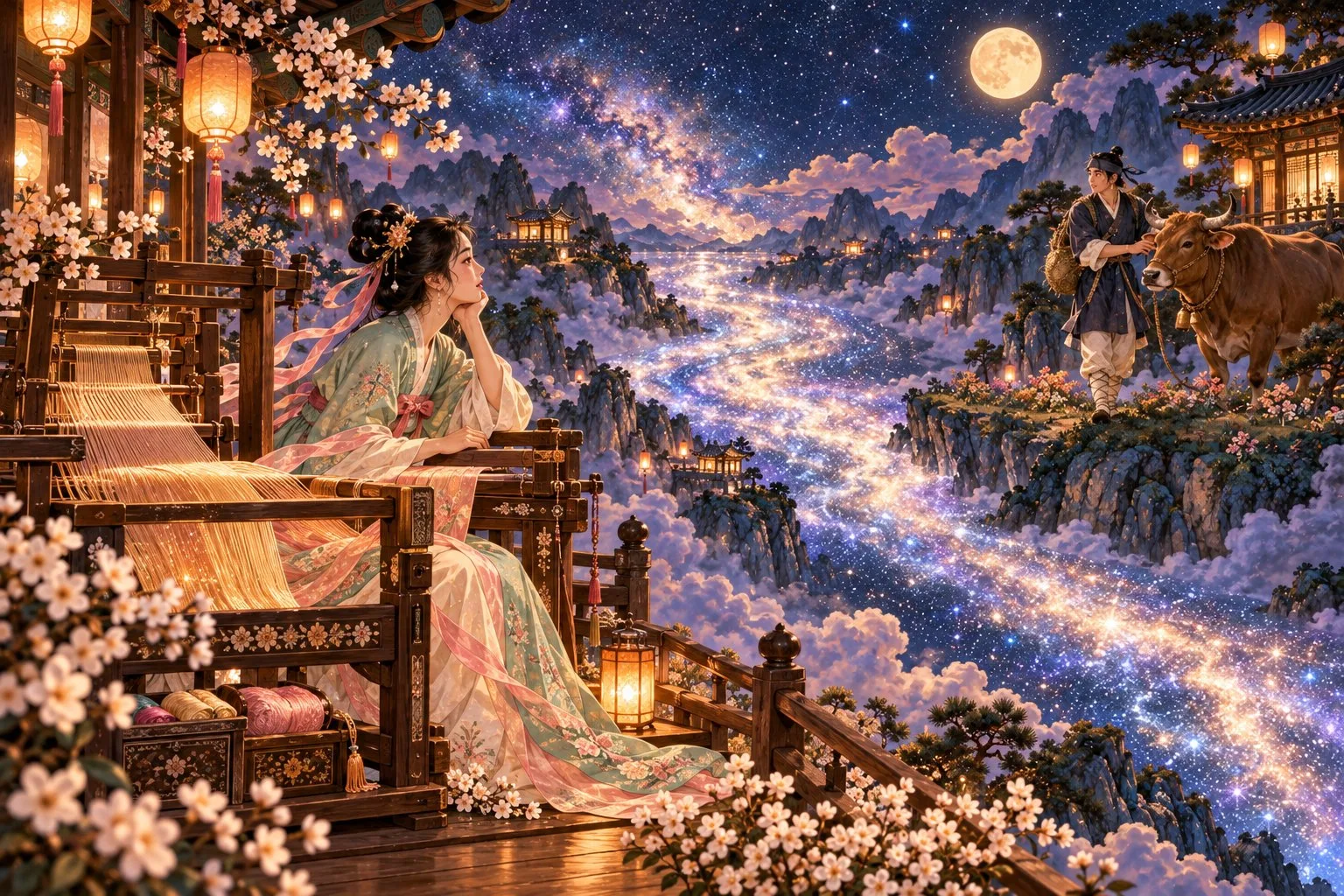
Sometimes Jiknyeo wove a pattern of birds into her cloth without meaning to, and then sat staring at it with tears in her eyes. Sometimes Gyeonu stood at the water’s edge at sunset with his oxen grazing behind him, and called her name across the river, though he knew she could not hear.
When at last the seventh night of the seventh month came, they both ran down to the river’s edge.
But the River of Stars was too wide to shout across, and too deep to wade. There was no bridge, and no boat, and no way over. They stood on opposite banks, stretching out their arms toward each other, and wept.
Their tears fell from the sky as rain. It rained, and rained, and rained, and on the earth below the rivers rose and spilled over their banks and flooded the fields.
The bridge of birds
Down on earth, the crows and magpies looked up and saw the two lovers weeping on either side of the river. They could not bear it.
So every crow and every magpie in the land rose up into the sky together, in one great black-and-white cloud. Up they flew, higher and higher, until they reached the River of Stars. There they spread their wings and lined up across the water, one beside the next, head to tail, until they had made a bridge of feathers stretching all the way from one bank to the other.
Gyeonu and Jiknyeo could hardly believe it. They stepped carefully onto the backs of the birds and ran across, and met in the middle, and held each other at last.
The birds called out to them, cawing and chattering, urging them on. “Quickly! Quickly! The night is short!”
For one whole night they were together. They talked about everything that had happened in the long year apart. They laughed and they cried. Then, as the sky in the east began to grow pale, they had to say goodbye, and walk back across the bridge to their own banks. The birds flew back down to earth, and the River of Stars flowed between them once more.
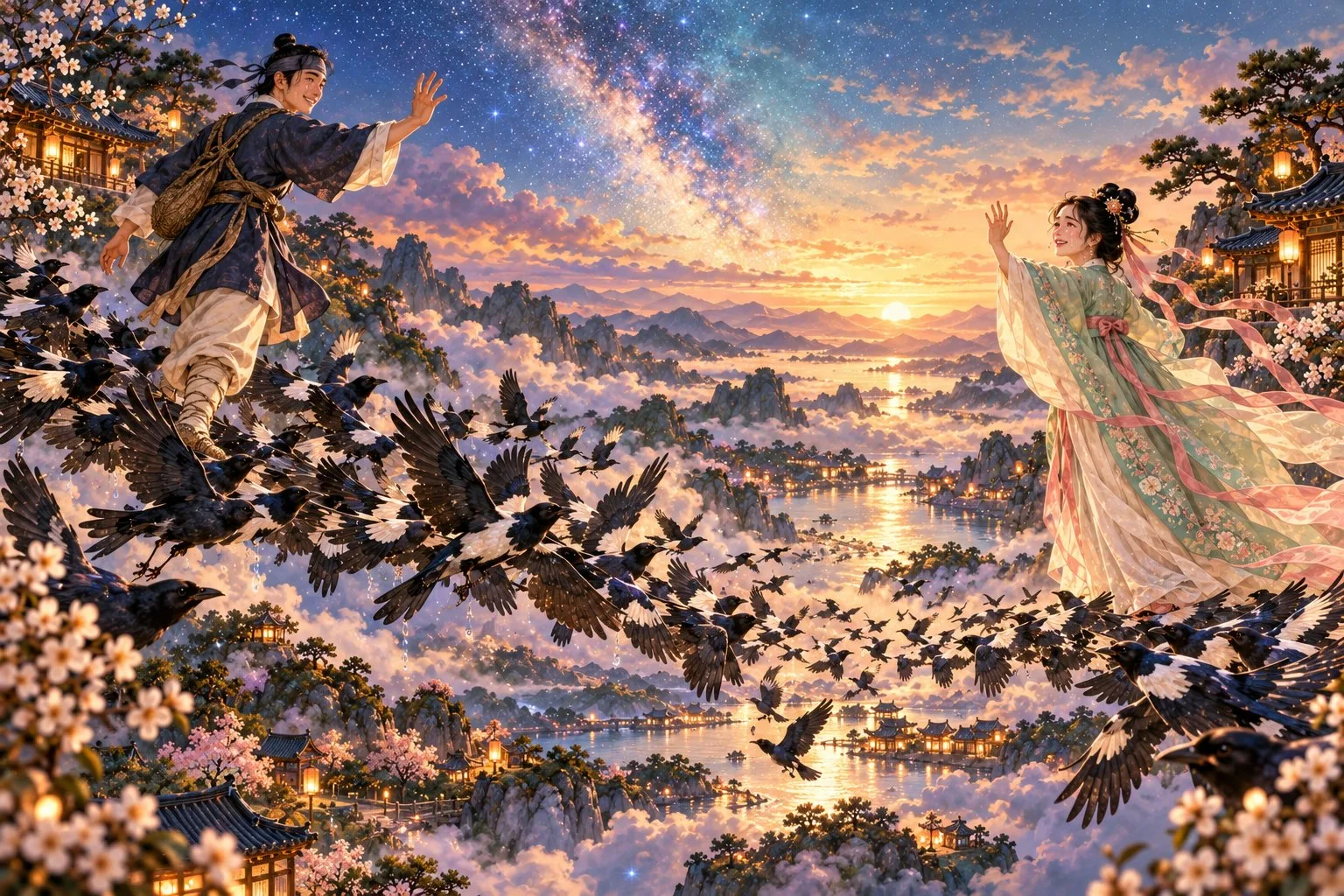
People say that if you look closely at the crows and magpies just after Chilseok, you will see that the feathers on the tops of their heads have worn away. That is where Gyeonu and Jiknyeo walked across them. And the bridge the birds made is called Ojakgyo, the Bridge of Crows and Magpies.
Chilseok, the seventh night
The seventh day of the seventh lunar month, usually in August, is Chilseok. On that night the two bright stars Altair and Vega appear to draw close together across the Milky Way. Rain on the evening of Chilseok is called chilseok-u and is said to be the lovers’ tears of joy at meeting, and rain on the morning after is their tears of parting. In the Goryeo dynasty, the history books record that King Gongmin and his queen made offerings to the herdsman and the weaver in the palace garden on this night.
Talk about it
Was the Heavenly Emperor’s punishment fair? Why do you think crows and magpies, ordinary birds of earth, are the ones who help? Can you find Altair and Vega in the summer sky?
Words to know
Gyeonu (견우) means “the one who leads the ox”. Jiknyeo (직녀) means “the weaving girl”. Eunhasu (은하수) is the Korean name for the Milky Way, “the silver river”. Ojakgyo (오작교) is the bridge of crows and magpies, and Chilseok (칠석) is the seventh night of the seventh month.
Where this story comes from
The story of Gyeonu the herdsman and Jiknyeo the weaver is told all over East Asia. It began in ancient China, where two bright stars on either side of the Milky Way, which we call Altair and Vega, were imagined as a herdsman and a weaving girl. The Encyclopedia of Korean Culture notes that a Chinese stone carving from the Han dynasty already shows the two stars, and the oldest written version of the full tale appears in the Jingchu suishi ji, a sixth-century record of Chinese festivals.
In Korea, the story is at least as old as the kingdom of Goguryeo. The Deokheung-ri tomb near Pyongyang, built in 408, has a wall painting of the Milky Way with a herdsman leading an ox on one side and a weaver with a dog on the other. The tale has been told in every part of Korea ever since and is tied to the festival of Chilseok, the seventh day of the seventh lunar month.
What it means
The Encyclopedia of Korean Culture reads the story first as a tale about marriage and responsibility. When two people marry, each takes on new duties, and Gyeonu and Jiknyeo's punishment, a year of waiting for every single day together, comes from forgetting theirs. Seen as myth, the endless cycle of brief meeting and long parting mirrors the turning of the heavens, and the weaver's loom can be read as the work of creation itself, which stops when she stops weaving.
For most Koreans, though, it is simply the most famous love story in the sky. It has given the language a proverb, "even a crow does not forget Chilseok", and inspired poems from the Goryeo and Joseon periods and folk songs still sung today.
Sources & further reading
Retold from the outline of the tale in the Encyclopedia of Korean Culture entry "견우직녀 설화", with festival customs from the entry on Chilseok. It is an English adaptation, not a translation.
- Encyclopedia of Korean Culture · 견우직녀 설화 (the herdsman and the weaver) ↗
- Encyclopedia of Korean Culture · 칠석 (Chilseok) ↗
Illustrations are imaginative interpretations, not historical records. Read our editorial policy.