In the reign of King Sejong, in the capital, there lived a high minister named Hong. He had a noble wife and a fine elder son, Inhyeong. But one day he dreamed that a blue dragon came roaring towards him out of a thunderstorm, and he knew it meant a remarkable son would be born. Not long after, a maid of the household named Chunseom gave birth to a boy. They called him Gildong.
From the very beginning, Gildong was extraordinary. He learned to read faster than his teachers could teach him. He studied strategy, the stars and the secret arts of the Daoist masters, and before he was grown he could do things no ordinary boy could do. He was handsome, brave and wise. And none of it mattered.
His father was proud of him in secret. Sometimes the minister watched the boy reading in the garden, or practising with a wooden sword, and thought that of all his family, this was the one most like himself. But he never said so out loud.
Because his mother was a servant, Gildong was a seoja, a son born outside the proper marriage. In the household of a noble family that meant he was something less than a son. He could not hope to sit the great examinations or rise to high office. He was not even allowed to call his father “Father”, or his brother “Brother”. He had to address them by their titles, like a servant.
One moonlit night, when he was eleven years old, Gildong could bear it no longer. He went to his father and bowed. “Father,” he began, and the minister cut him off sharply. Gildong tried again, his eyes full of tears. “All my life I have wanted to call you father, and I may not. What kind of person is it who cannot call his father ‘father’ and his brother ‘brother’?” The minister felt for his son, but he only scolded him and sent him away.
Gildong went back to his mother’s small room at the edge of the household. Chunseom held him while he cried, and cried with him, because she knew there was nothing either of them could do. It was not the minister’s choice, she told him. It was the way the world was made.
The assassin
Others in the household were not so kind. One of the minister’s concubines, jealous of Gildong and his mother, whispered that the boy’s gifts were dangerous, that a seoja so brilliant would surely bring disaster on the family one day. She hired a fortune-teller to say the same thing to the minister’s wife, and an assassin named Teukjae to kill the boy in the night.
But Gildong had read the signs. When Teukjae crept into his room with a dagger, the room was suddenly no longer a room. Wind howled, rocks and trees rose around him, and he found himself lost on a wild mountainside, with Gildong standing before him. Gildong took the assassin’s own dagger and ended his life. Then he went to his mother, bowed to her, told her he must leave, and walked out of his father’s house into the world.
The band that helps the poor
Gildong wandered the mountains until he came upon a den of outlaws who were arguing over who should be their leader. Whoever could lift an enormous stone, they decided, should be chief. Gildong lifted it easily. Then, as his first test, he led them in a clever raid on the treasury of the great temple of Haeinsa, carrying off its riches without anyone getting hurt.
The outlaws stared. The stone was so big that three of them together had barely been able to rock it. Gildong set it down again without even breathing hard, dusted off his hands, and asked politely whether anyone else would like to try.
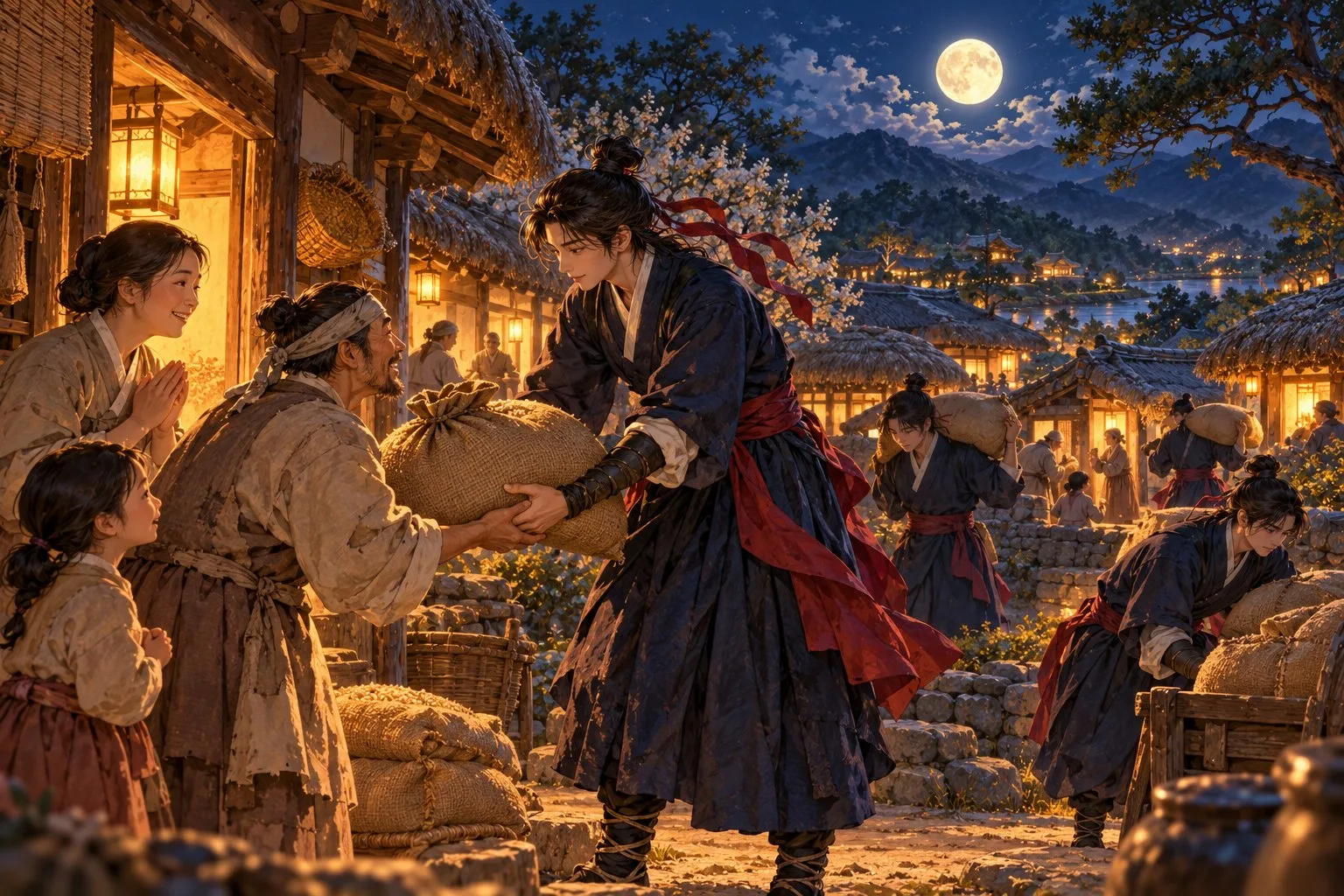
The outlaws made him their leader, and Gildong gave his band a new name: the Hwalbindang, the Party to Help the Poor. They would never rob ordinary people, he told them. Instead they would take back what corrupt officials had squeezed out of the farmers and fishermen of the eight provinces, and give it to those who needed it.
And so they did. When a provincial governor’s storehouses were emptied overnight, the farmers who had paid too much in taxes found grain at their doors. Governors all over Korea began to dread the name Hong Gildong. When the governor of Hamgyeong province reported that his treasury had been robbed, the king himself ordered the outlaw captured.
Gildong had even left a note pinned to the empty treasury door, signed with his own name, so that no innocent person would be blamed for what he had done.
Eight Gildongs
That was easier said than done. Gildong could call up wind and rain, change his shape and vanish at will. A royal police captain set out to catch him and ended up tricked, humiliated and sent home a laughing stock.
Soldiers marched into the hills and came back empty-handed. Spies were sent among the outlaws and came back with nothing but stories, each stranger than the last. Some said Hong Gildong could fly. Some said he could be in two places at once. That last rumour, as it turned out, was not quite right. It was more than two.
Then reports came in from all eight provinces at once: Hong Gildong had robbed an official here, Hong Gildong had been seen there, all on the very same day. Gildong had made seven straw figures and breathed life into them, and now eight identical Gildongs were at large across Korea. When the king’s men finally managed to arrest one and bring him to the palace, eight Gildongs were brought before the throne, each claiming to be the real one, each pointing at the others. As the king watched, seven of them turned back into bundles of straw.
At last the court tried another way. They sent for Gildong’s father, and for his brother Inhyeong, who was now a governor. Gildong let his brother “capture” him, but slipped his chains again and again. Finally he made the king an offer. “Make me Minister of War,” he said, “and I will trouble your kingdom no more.” The king, who had run out of ideas, agreed. Gildong came to the capital, bowed before the throne as Minister of War, thanked the king, and then rose into the air on a cloud and was gone.
The island kingdom
Gildong led his followers across the sea. On the way to China they came upon a beautiful island country called Yuldoguk, with green mountains and clear rivers. There Gildong fought and destroyed a band of monsters who had carried off two young women, rescued them, and married them. In time, through his wisdom and courage, he became king of Yuldoguk.
Before he left, he asked the king for one last thing: a thousand sacks of rice, to feed his people on the voyage. The king, glad to see the back of him, gave it gladly. Gildong’s ships sailed out of the harbour loaded to the waterline, and the outlaws on deck sang as Korea slipped away behind them.

When news came that his father had died, Gildong returned to Korea to mourn him for the full three years, as a true son should. No one could tell him now what he could or could not call his father. Then he went home to his island and ruled it so well that the people lived in peace and plenty, with no one held back because of the circumstances of their birth.
The real Hong Gildong
There really was a Hong Gildong. The annals of the Joseon court record a notorious bandit chief of that name, captured around 1500, whose gang had dressed as officials and raided government offices. The novel’s hero borrowed his name, but gave him magic, a cause and a kingdom.
Talk about it
Why does Gildong care so much about what he is allowed to call his father? Is it right to steal from corrupt officials to help the poor? And why do you think the story sends him away to found his own country instead of changing Korea?
Words to know
Seoja (서자) was the son of a nobleman by a concubine or servant, barred from many rights. Hobu hohyeong (호부호형) means calling one’s father “father” and one’s brother “brother”. The Hwalbindang (활빈당) is Gildong’s “Party to Help the Poor”. Yuldoguk (율도국) is the island kingdom he founds.
Where this story comes from
Hong Gildong jeon (홍길동전, The Tale of Hong Gildong) is traditionally said to have been written by the scholar and official Heo Gyun (1569–1618), and is often called the first novel written in the Korean alphabet. The Encyclopedia of Korean Culture explains that this attribution rests on a note by Heo Gyun's contemporary Yi Sik, and that some scholars doubt it, partly because the book was not among the charges brought against Heo Gyun when he was executed. The encyclopedia concludes that unless new evidence turns up, Heo Gyun's authorship cannot be ruled out, but that the versions we have today are certainly later and changed from whatever he wrote. No original survives.
The story was probably inspired by a real Hong Gildong, a notorious outlaw recorded in the annals of the Joseon court around 1500, and by oral legends about the leaders of peasant uprisings. Its ideas match Heo Gyun's own essays, which attacked a system that wasted talented people because of their birth and condemned officials who squeezed the common people. The many versions fall into Seoul, Jeonju and manuscript families; the Seoul 30-page edition is thought to show the original shape best.
What it means
At the heart of the tale is one painful line: Gildong may not call his father 'father' or his brother 'brother'. In Joseon society, the sons of noblemen by concubines or servants, called seoja, were barred from high office and treated as second-class members of their own families, however talented they were. Gildong's story begins with that injustice, and the Encyclopedia of Korean Culture notes that the Seoul editions keep returning to it.
From there the tale widens into an attack on corrupt officials and a fantasy of justice. Gildong never touches the property of ordinary people; he takes only what officials have taken unfairly, and gives it to the poor. The encyclopedia suggests that the later part of the story, in which Gildong founds his own ideal kingdom, was added to give ordinary people the victory that real rebels never won. It is a strongly critical work, quite unlike the many light, commercial novels that followed it, and Hong Gildong has become Korea's Robin Hood, the hero of films, cartoons and a byword for anyone who seems to be everywhere at once.
Sources & further reading
Retold from the outline of Hong Gildong jeon in the Encyclopedia of Korean Culture entry "홍길동전". Some scenes follow the widely known Seoul editions. It is an English adaptation, not a translation.
Illustrations are imaginative interpretations, not historical records. Read our editorial policy.