Long ago, at the foot of a wooded mountain, there lived an old couple and their two sons. The elder son had inherited the best of everything and still complained that it wasn't enough. The younger son had very little and rarely complained at all. Every morning, while his brother was still asleep, he took a rope and an A-frame carrier and climbed the mountain to cut firewood for the house.
One autumn day he was working under a big tree when something small and round bounced down the slope and rolled up against his foot. It was a hazelnut, a gaeam, brown and shiny and perfectly ripe. He picked it up and turned it over in his fingers. “This one is for my father,” he said, and tucked it into his jacket. A moment later another nut came rolling down. “This one is for my mother,” he said. A third followed, and he said, “This one is for my brother.” Only when a fourth bounced against his ankle did he smile and say, “And this one is for me.”
He was so pleased with his little harvest that he kept hunting under the leaves for more, and he didn’t notice how low the sun had dropped. By the time he looked up, the shadows had run together and the path had disappeared. He wandered for a long while among the dark trees, his heart thumping at every crack of a twig, until at last he saw the outline of a roof in a clearing. It was an old house, long abandoned, its paper doors torn and its courtyard full of weeds. Nobody answered when he called out. It wasn’t a welcoming place, but it was better than a night in the open with wolves and tigers about, so he went inside, climbed up onto a crossbeam under the roof where nothing could reach him, wedged himself against the rafters and fell asleep.
He woke in the middle of the night to the loudest noise he had ever heard. Drums were banging, feet were stamping and someone was laughing like a donkey. He peered down from his beam and almost fell off it. The room below was full of dokkaebi. There were tall ones and squat ones, ones with a single horn and ones with wild bushy hair, all of them grinning with enormous mouths, and every one of them carried a knobbly wooden club.
“Let’s have a party!” shouted the biggest. He thumped his club on the floor and called out, “Gold, come out, ttukttak!” A heap of gold coins tumbled out of nowhere and rang across the floorboards. “Silver, come out, ttukttak!” called another, and silver poured out after it. “Rice cakes, come out! Meat, come out! Wine, come out!” the others shouted, banging away, and in no time the floor was covered with steaming dishes and jars of drink. The goblins fell on the food, sang at the tops of their voices, wrestled each other and danced in circles until the old house shook.
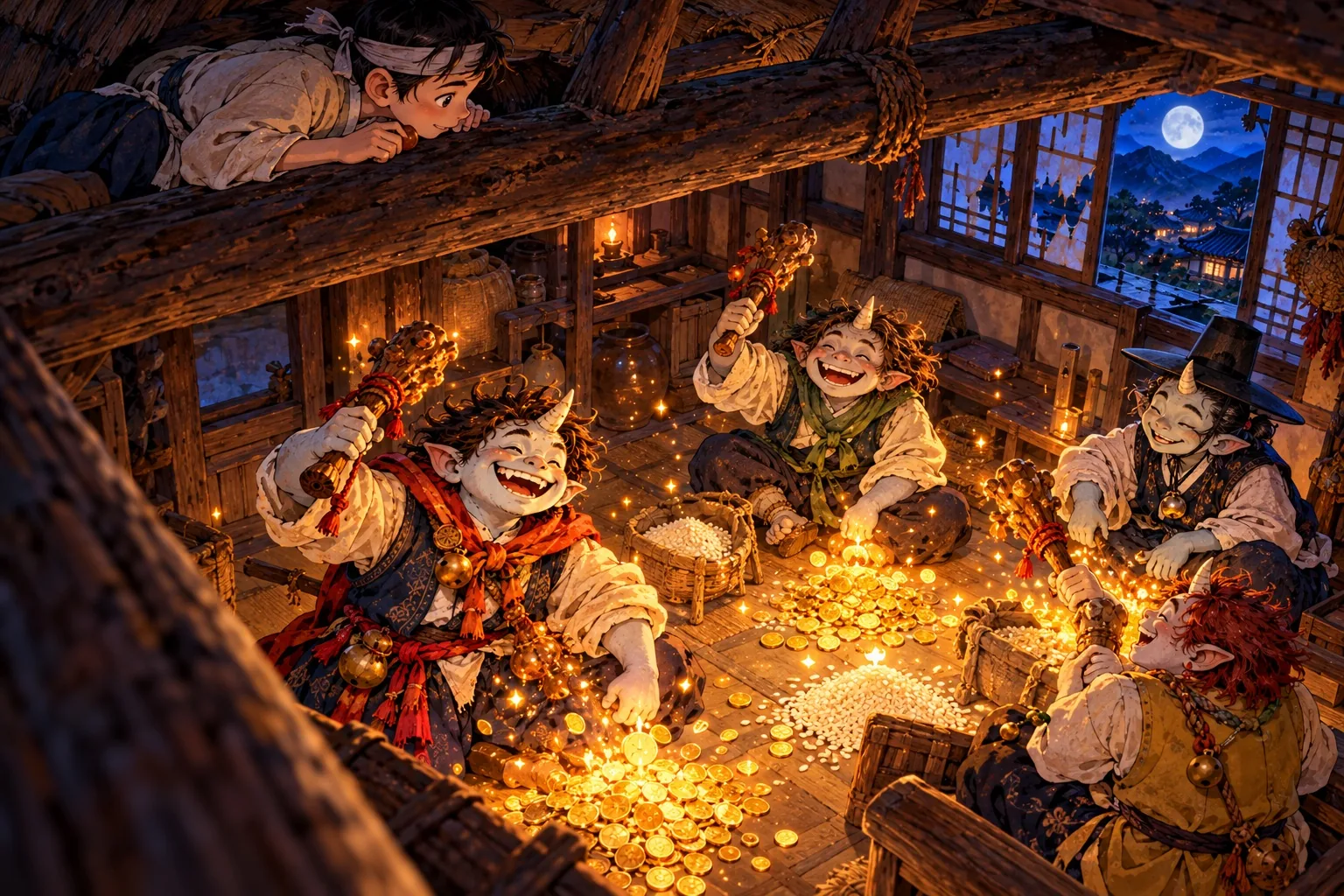
Up in the rafters, the boy didn’t dare move. He watched for what felt like hours, and the smell of all that food drifted up to him until his stomach began to growl. He hadn’t eaten since the morning. Without really thinking about it, he slipped a hand into his jacket, took out one of the hazelnuts and bit down on it.
The goblins were having the time of their lives. They ate with both hands, they sang songs with no tune at all, and two of them started a wrestling match in the middle of the floor and knocked over a pile of rice cakes. Every time one of them wanted something new, out came the club. Thump: a jar of wine. Thump: a roast pig. Thump: a heap of silver coins, which they threw at each other for fun.
Ttak!
In the hollow old house the crack of the shell sounded like a beam splitting in two. Every dokkaebi froze. The drums stopped. One of them looked up at the dark roof, his eyes huge. “The rafters are breaking!” he screamed. “The house is falling down!” shrieked another. “Run!” In a moment the whole party was scrambling for the doors, tripping over each other, knocking over the wine jars, dropping their gold and their rice cakes. They burst out into the night and fled howling into the forest, and the house was suddenly, completely silent.
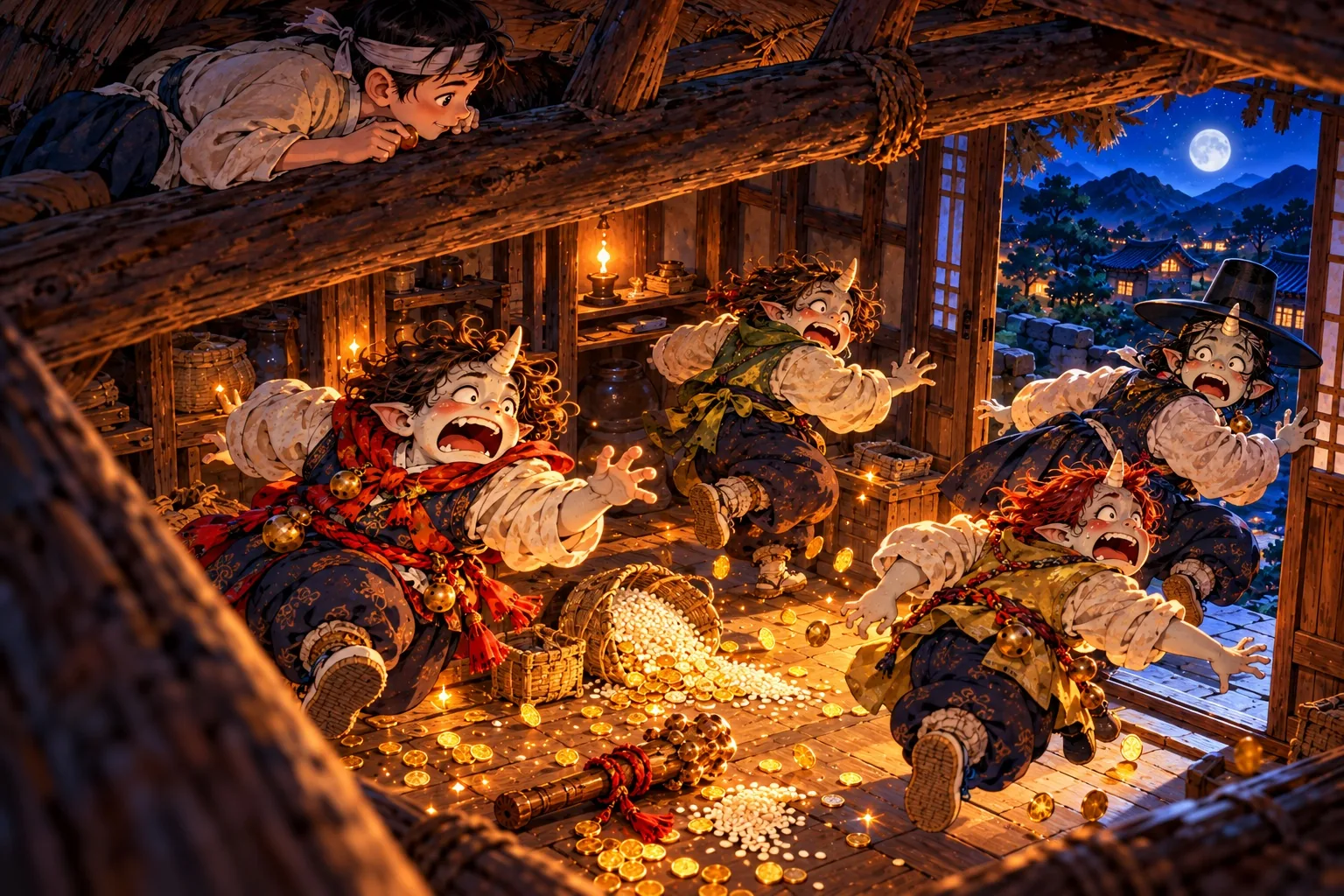
The boy stayed where he was until the first grey light came through the torn doors. Then he climbed down. The food and treasure had vanished with the goblins, the way goblin things do, but lying in the middle of the floor was one knobbly wooden club that somebody had dropped in the rush. He picked it up, a little nervously, and gave the floor a tap. “Rice, come out,” he whispered. A sack of rice appeared at his feet.
He carried the club home and gave his father, his mother and his brother each a hazelnut, just as he had promised. After that the family never went hungry. With a tap of the club he made rice for the winter, warm cloth for his parents and money to mend the leaking roof, and he was careful never to ask for more than they needed.
His elder brother watched all this with narrowed eyes. He didn’t care about the rice or the roof. What he cared about was that his little brother had something he didn’t. He pestered him until the whole story came out, and the very next morning he set off up the mountain.
He had always thought of himself as the clever one, and it galled him that his soft-hearted little brother had stumbled into a fortune just by being polite to his parents. If a fool could do it, he reasoned, a clever man could do it better.
He found the big tree and sat down underneath it to wait. Sure enough, a hazelnut came rolling down the slope. He snatched it up. “This one’s mine,” he said. Another came. “This one’s mine too.” A third came, and he thought about it for a moment and said, “Well, I suppose this one could go to my parents.” Then he put the nuts in his pocket and went looking for the empty house.
He found it, climbed into the rafters and waited for night. Before long the drums started, and the dokkaebi came crowding in with their clubs, calling up gold and silver and food just as before. The elder brother didn’t wait to be hungry. As soon as the party was in full swing, he pulled out a hazelnut and bit down as hard as he could.
Ttak!
This time nobody ran. The goblins went quiet and turned their heads, slowly, all together, to look up at the rafters. “That’s the noise,” growled the biggest. “That’s the noise we heard the night our club went missing.” “It’s the thief!” shouted another. “He’s come back for more!”
They hauled the elder brother down by his ankles and gave him a beating he never forgot. When they were finished, the biggest dokkaebi grabbed him by the nose. “So you like taking things that belong to other people?” he said. “Then let’s give you something extra.” He tapped the elder brother’s nose with his club. “Nose, grow longer, ttukttak!” The nose stretched. “Longer!” It stretched some more. The goblins took turns, laughing until they cried, until the elder brother’s nose hung down past his chin like an elephant’s trunk.
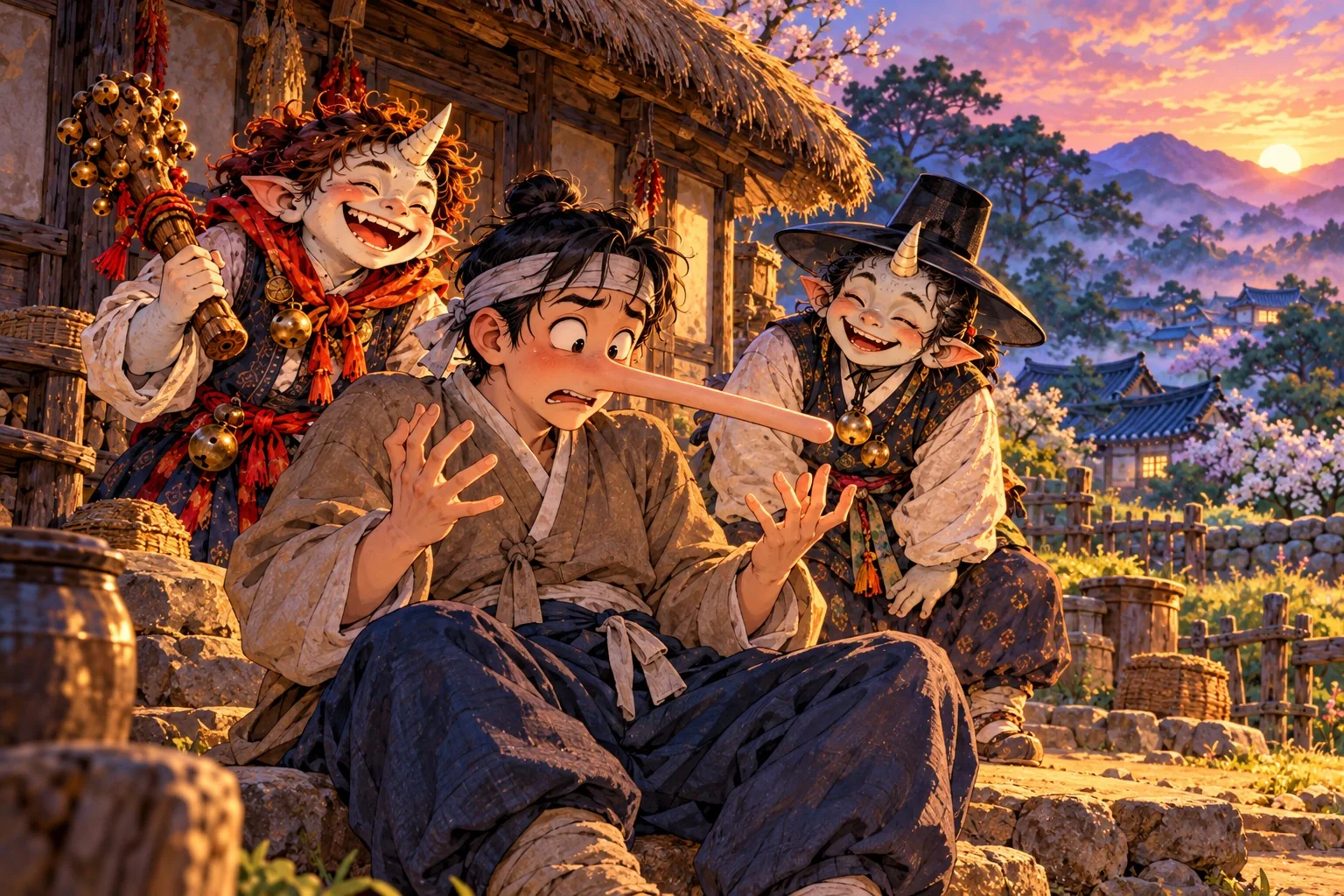
In the morning he crept home with nothing in his pockets, bruises all over and a nose that wouldn’t fit through the door. His younger brother took one look at him, sighed, and went to fetch some cold water and a cloth. Even then, the storytellers say, he never once said “I told you so.”
What are dokkaebi like?
Dokkaebi (도깨비) are the goblins of Korean folklore, and they are much more mischievous than wicked. In folk belief they often begin life as an old household object, such as a worn-out broom, a cracked pot or a discarded flail, that comes to life after being handled for many years. They are strong, noisy and fond of fun. They challenge travellers to wrestling matches on lonely roads, they love a party, and they are famously partial to buckwheat jelly, memilmuk. They are also easy to fool, which is why so many Korean stories end with a human outwitting them.
Their clubs are their most famous possession. A dokkaebi bangmangi can conjure whatever its owner asks for with a tap and a “ttukttak!”, and the phrase is still used in everyday Korean for any magical shortcut to riches. Dokkaebi can be generous to people they like, but they have long memories and a sharp sense of fairness. In this story they are dangerous only once, and only to someone they believe has robbed them.
Talk about it
Why does the same trick work for one brother and fail so badly for the other? If you had a dokkaebi club for one day, what would you ask it for, and what would you be careful not to ask for? And do the dokkaebi seem like villains to you, or do they have a point?
Words to know
Dokkaebi (도깨비) are Korean goblins. Bangmangi (방망이) means a club or bat. Gaeam (개암) is a hazelnut. Ttukttak (뚝딱) is the sound of a quick tap, and the word the goblins shout when they use their clubs. Memilmuk (메밀묵) is buckwheat jelly, said to be the dokkaebi’s favourite food.
Where this story comes from
This is one of the most widely told folktales in Korea, recorded all over the country under names such as Ttukttak bangmangi (the tap-tap club), Bobae bangmangi (the treasure club) and Dokkaebi-wa gaeam (the dokkaebi and the hazelnut). In every version the good and bad characters are sorted in the very first scene, by the order in which they pick up the nuts. The pair are sometimes brothers and sometimes neighbours. When they are brothers, the greedy one is usually the elder, which folklorists read as a quiet complaint about the eldest son's privileges in a traditional household.
The pattern is very old. A Tang-dynasty Chinese miscellany, the Youyang Zazu (酉陽雜俎) by Duan Chengshi, records a story from Silla about two brothers called Banga (방이), in which a magic gold club is found among goblins and the greedy brother's nose is pulled out as long as an elephant's trunk. A version close to the modern tale was printed in a 1924 collection of Korean children's stories, and since then it has appeared in picture books and school readers for generations. How the greedy brother is punished changes from teller to teller: in some he is only beaten, in others the goblins stretch his arms, legs or nose. We kept the long nose, which goes back to the Banga story.
What it means
The two brothers do exactly the same things. They climb the same mountain, find the same tree, hide in the same rafters and crack the same kind of nut. The only difference is the first thing each of them says, and that is the whole point of the story. One brother picks up a hazelnut and thinks of his father. The other picks one up and thinks of himself. Everything that happens afterwards grows out of that small moment.
Korean folklore calls this kind of story a mobangdam, an imitation tale, and it is one of the tradition's favourite shapes. A good person is rewarded almost by accident, a greedy person copies every step to get the same reward, and the copy goes wrong because the reason behind it was wrong. The same structure drives Heungbu and Nolbu, and the tale of the old man who went to have his lump removed and came home with two. The lesson is not that luck is unfair. It is that you cannot borrow someone else's good fortune by copying the outside of what they did.
The dokkaebi themselves come off rather well. They are noisy, greedy for fun, and easily frightened, but they are not cruel until they think they have been robbed. Seen from their side, the second visit is simply the moment a thief came back to the scene of the crime.
Sources & further reading
Retold from the common Korean versions of the dokkaebi club tale, following the plot, alternative titles and variants summarised by Park Hyeon-suk in the Encyclopedia of Korean Culture (Academy of Korean Studies), entry "도깨비방망이 설화", which cites the Compendium of Korean Oral Literature (한국구비문학대계) and the Silla tale of Banga recorded in the Youyang Zazu. It is an English adaptation, not a translation.
- Encyclopedia of Korean Culture · 도깨비방망이 설화 ↗
- National Folk Museum of Korea · Encyclopedia of Korean Folklore and Traditional Culture · 도깨비방망이 ↗
Illustrations are imaginative interpretations, not historical records. Read our editorial policy.