Long ago, a young scholar was travelling on foot through the mountains of Gangwon province, on his way to the capital to sit the great examination. The path was steep and lonely, and the trees grew so thick that the afternoon light came through them green.
He had been walking for many days. His straw sandals were worn thin, his pack held only a few books, a little dried food and a hunting bow his father had given him, and his head was full of the classics he had spent years memorising. If he passed the examination, his family’s fortunes would change. If he failed, he would have to wait years for another chance. So he walked quickly, muttering passages to himself as he went.
Suddenly he heard a frantic chattering above him. He looked up and saw a magpie’s nest high in a tree, and coiled around the branch beneath it, a huge snake. Its head was rising towards the nest, where a cluster of baby magpies cried and huddled together while their parents flapped and screamed helplessly around the snake’s head.
The scholar stood frozen for a moment, staring up. The snake was thicker than his arm, its scales dull green and black, and it moved with a slow, horrible patience, as if it knew there was no hurry. One of the parent birds dived at its eyes and was flicked away. The chicks shrieked. Their tiny beaks gaped open, pink and helpless.
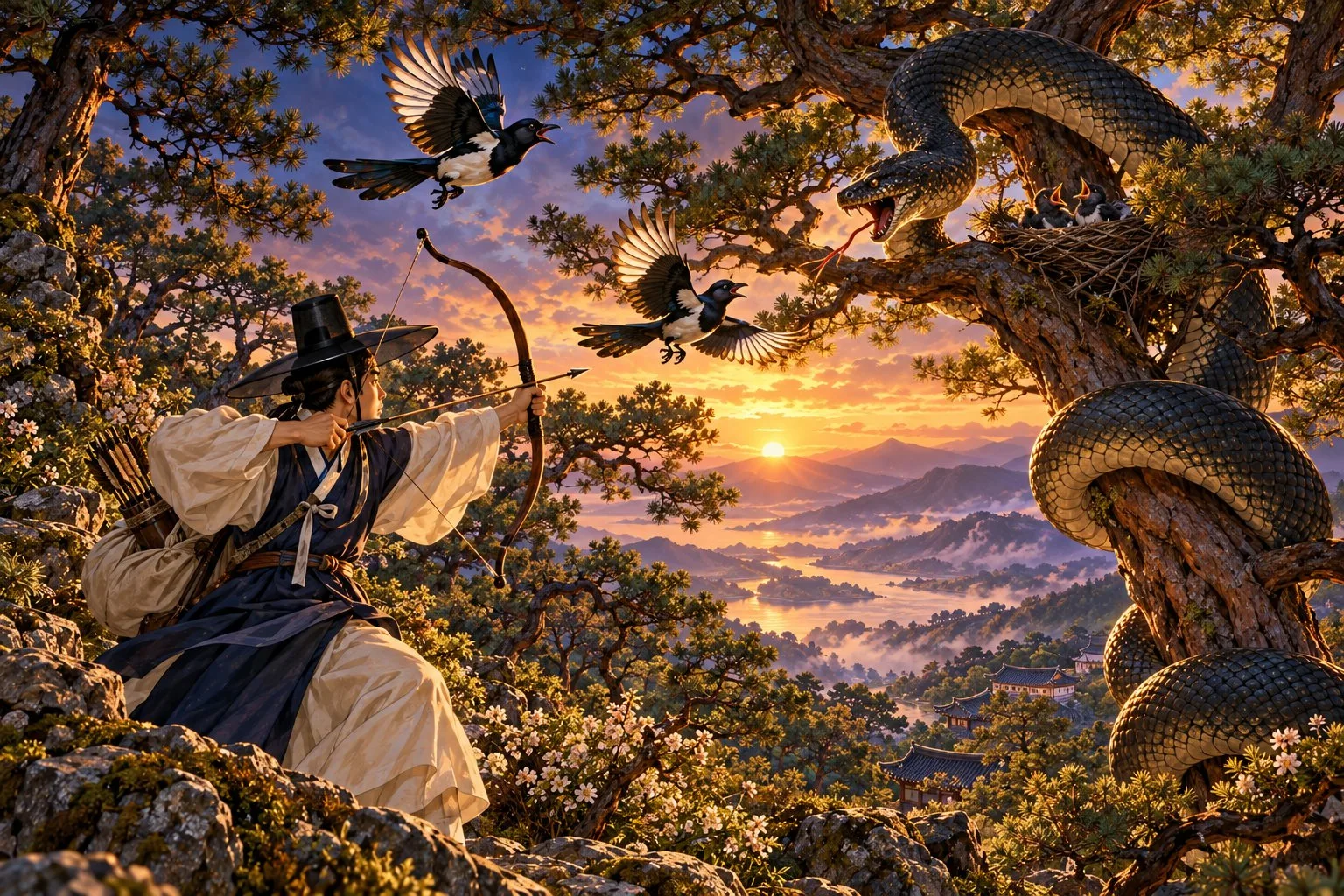
The scholar did not hesitate. He took the bow from his shoulder, fitted an arrow and shot. The arrow struck the snake, and it fell writhing to the ground and lay still. The parent magpies swooped down to their chicks, and the scholar, pleased to have done a good deed, shouldered his bow and walked on.
For a while he could still hear them behind him, chattering and calling, as if they were following him through the trees. He smiled to himself, and then forgot about them, and went back to reciting his books.
The house in the mountains
By the time he was deep in the mountains, night had fallen. He was cold, tired and hungry, and he had no idea where he would sleep. Then, through the trees, he saw a single light. He followed it and came to a small, neat house standing all alone.
It was a strange place for a house, so far from any village, with no fields around it and no path leading to its door. But the light in the window was warm and yellow, and smoke curled from the chimney, and the scholar was far too tired to wonder about it.
He knocked, and a beautiful young woman opened the door. She seemed almost to have been expecting him. She welcomed him in, set out a fine supper and made up a warm bed for him in a side room. The scholar thanked her again and again, and fell asleep as soon as his head touched the pillow.
He did notice, as he ate, that she hardly spoke, and that she watched him the whole time with dark, unblinking eyes. But he told himself she was simply shy, living out here all alone, and thought no more about it.
In the middle of the night he woke, gasping. Something was squeezing his chest and throat. He could hardly breathe. He opened his eyes, and in the darkness he saw that the woman was gone. In her place, coiled around his body with its cold head right before his face, was an enormous snake.
“Do you know who I am?” the snake hissed. “This afternoon you shot my husband. Now I will have your life in return.”
Her tongue flickered against his cheek. Her eyes, which had been a woman’s eyes at supper, were now narrow and yellow, and they did not blink.
The scholar begged for mercy. He had only meant to save the baby birds, he said. He had not known.
“Your husband was about to eat helpless children,” he gasped. “What else could I do? Would you have had me stand there and watch?”
“He was hungry,” said the snake. “Snakes eat birds. That is the way of the mountains. You had no business interfering.” Her coils tightened a little more, and the scholar felt his ribs creak.
The snake was silent for a moment. “Very well,” she said. “There is an old bell in the ruined temple behind this house. No one has rung it for years. If that bell rings three times before dawn, I will let you go. If it does not, you die.”
The scholar almost laughed in despair. “How can a bell ring with no one to ring it?” he whispered.
“That,” said the snake, “is the point.” And she settled her coils around him and lay still, watching the window, waiting for the sky to grow light.
Three strokes of the bell
The scholar lay in despair. The temple was abandoned. There was no monk to ring the bell, and he could not move. He watched the window, and the night crept on, and the snake’s coils tightened, and he thought of his parents at home who would never know what had happened to him.
He prayed to heaven. He prayed to the mountain spirit. He tried to think of anyone, anything, that could ring an old bell in an empty temple in the middle of the night, and he could think of nothing at all. Hours passed. The snake did not sleep. Each time he stirred, he felt her coils shift and grip. Outside, the stars began to fade, and the sky over the ridge turned from black to the deepest blue. Dawn was coming, and the bell was silent.
Then, far off in the darkness, a sound rang out.
Dong.
The deep voice of the bell rolled through the mountains. The snake’s head jerked up.
Dong.
The scholar held his breath.
Dong.
The third stroke faded into the night. Slowly, the great coils loosened and slid away. The snake lowered her head, and in the grey light just before dawn she was gone.
What the scholar found
As soon as it was light, the scholar stumbled out of the house and climbed the slope behind it to the old temple. The bell hung in its tumbledown bell tower, silent now. And on the ground beneath it lay two magpies, their heads bloodied, quite dead.
They were the parent birds whose chicks he had saved. All night they had followed him, and when they saw the danger he was in, they had flown at the great bell again and again, striking it with their own heads, until it rang three times. It had cost them their lives.
He knelt down and picked one of them up. It weighed almost nothing. Its black and white feathers were still soft, and its little head was broken where it had struck the bronze.
The scholar wept. He buried the two magpies carefully beneath the bell tower before he went on his way.
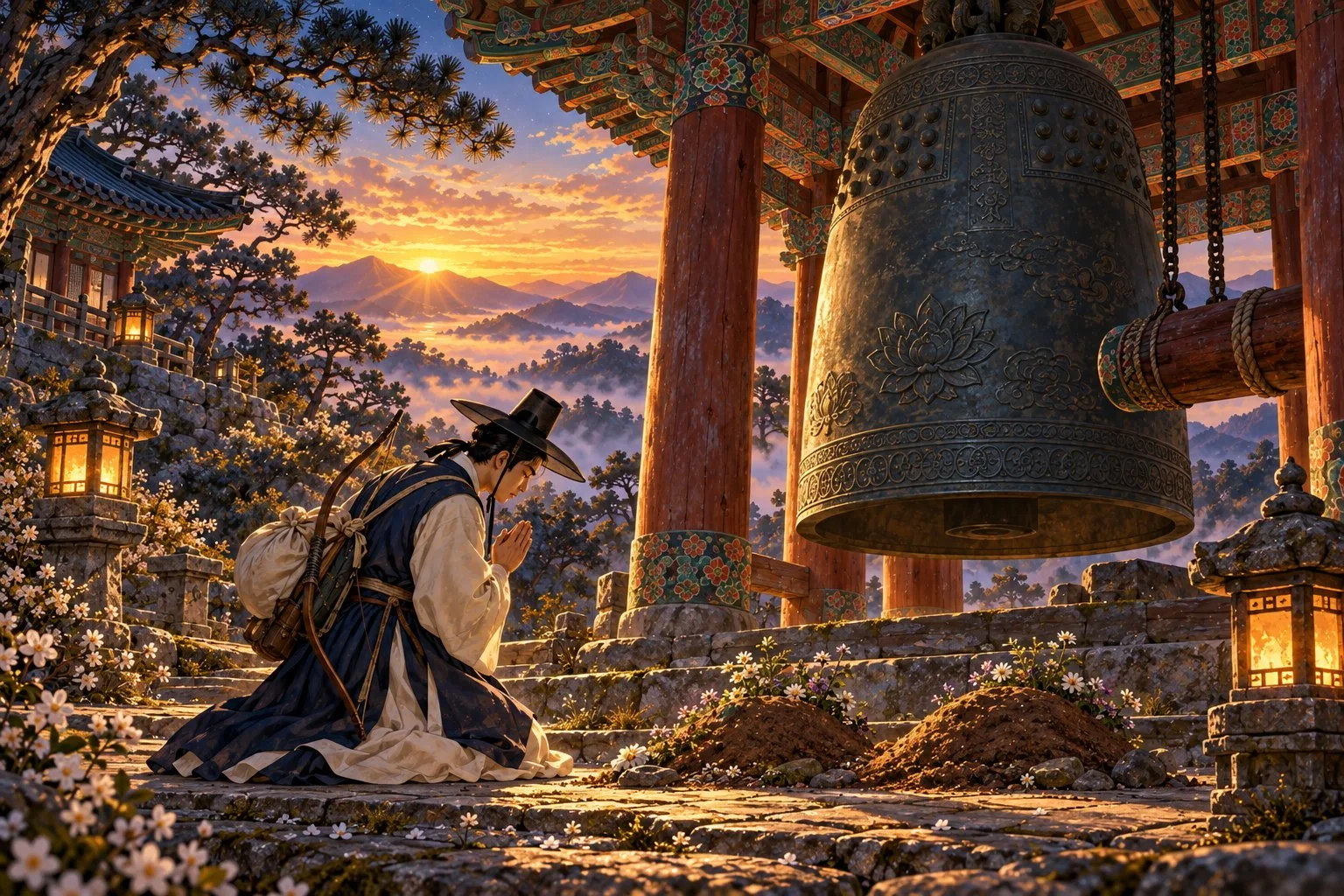
He stood for a long time beside the little grave, thinking about how small a thing he had done for them, one arrow on a mountain path, and how much they had given him back. Then he picked up his pack and his bow and walked on toward the capital, and for the rest of the journey he did not recite a single word of his books. He was thinking about the magpies.
In the version told around Wonju, the birds were pheasants, not magpies, and the temple was Sangwonsa, high on the mountain. That, people say, is why the mountain has been called Chiaksan, Pheasant Peak, ever since.
The bell that freed the snake
In some tellings, the snake was not only taking revenge. She and her husband had been waiting to rise to heaven as dragons, and the sound of a temple bell was what she needed to be released. When the bell rang, it set her free as well as the scholar. That is why she kept her promise and slid away, and why, in these versions, the story ends with everyone, even the snake, finding peace.
Talk about it
Was the scholar right to shoot the snake? Is the snake a villain, or does she have a point? And why do you think a temple bell is what saves him?
Words to know
Kkachi (까치) is a magpie, a bird of good news in Korea. Boeun (보은) means repaying a kindness. Chiaksan (치악산) is a mountain near Wonju whose name means “Pheasant Peak”. Sangwonsa (상원사) is the mountain temple in the legend.
Where this story comes from
This tale, Kkachi-ui boeun (까치의 보은, "the magpie repays a kindness"), is told all over Korea. The Encyclopedia of Korean Culture notes that it is also called The Grateful Pheasant or The Origin of Chiaksan, because in the best-known version it explains the name of Chiaksan, a mountain near Wonju in Gangwon province whose name means "Pheasant Peak". In that telling the birds are pheasants, and the bell belongs to Sangwonsa, a temple founded in the Unified Silla period below Namdaebong peak, where the legend is still told today.
The encyclopedia also records a variant in which the snake's spirit turns into food and enters the hero's stomach, making him gravely ill, and a magpie saves him by pecking out the baby snakes. The story told here follows the most common outline.
What it means
On the surface this is a simple lesson about kindness repaid. The traveller saves the baby birds, and the birds save him at the cost of their own lives. Korean folklore is full of animals that repay kindness, and the magpie, a bird of good news in Korean belief, is a natural hero for such a story.
But the Encyclopedia of Korean Culture points out that the bell gives the tale a deeper meaning. In some versions, the snake had been close to rising to heaven as a dragon, and the sound of the temple bell sets her free, so the birds' sacrifice saves not only the traveller but also the grieving snake. The bell rings out a kind of salvation for everyone. The snake herself is not simply a villain either: she is a widow avenging her husband, and the story lets us feel for her as well.
Sources & further reading
Retold from the outline of the tale in the Encyclopedia of Korean Culture entry "까치의 보은", with the setting of Chiaksan and Sangwonsa from the entry on the Sangwonsa site. It is an English adaptation, not a translation.
- Encyclopedia of Korean Culture · 까치의 보은 (the grateful magpie) ↗
- Encyclopedia of Korean Culture · 상원사지 석탑 및 광배 (Sangwonsa temple site) ↗
Illustrations are imaginative interpretations, not historical records. Read our editorial policy.