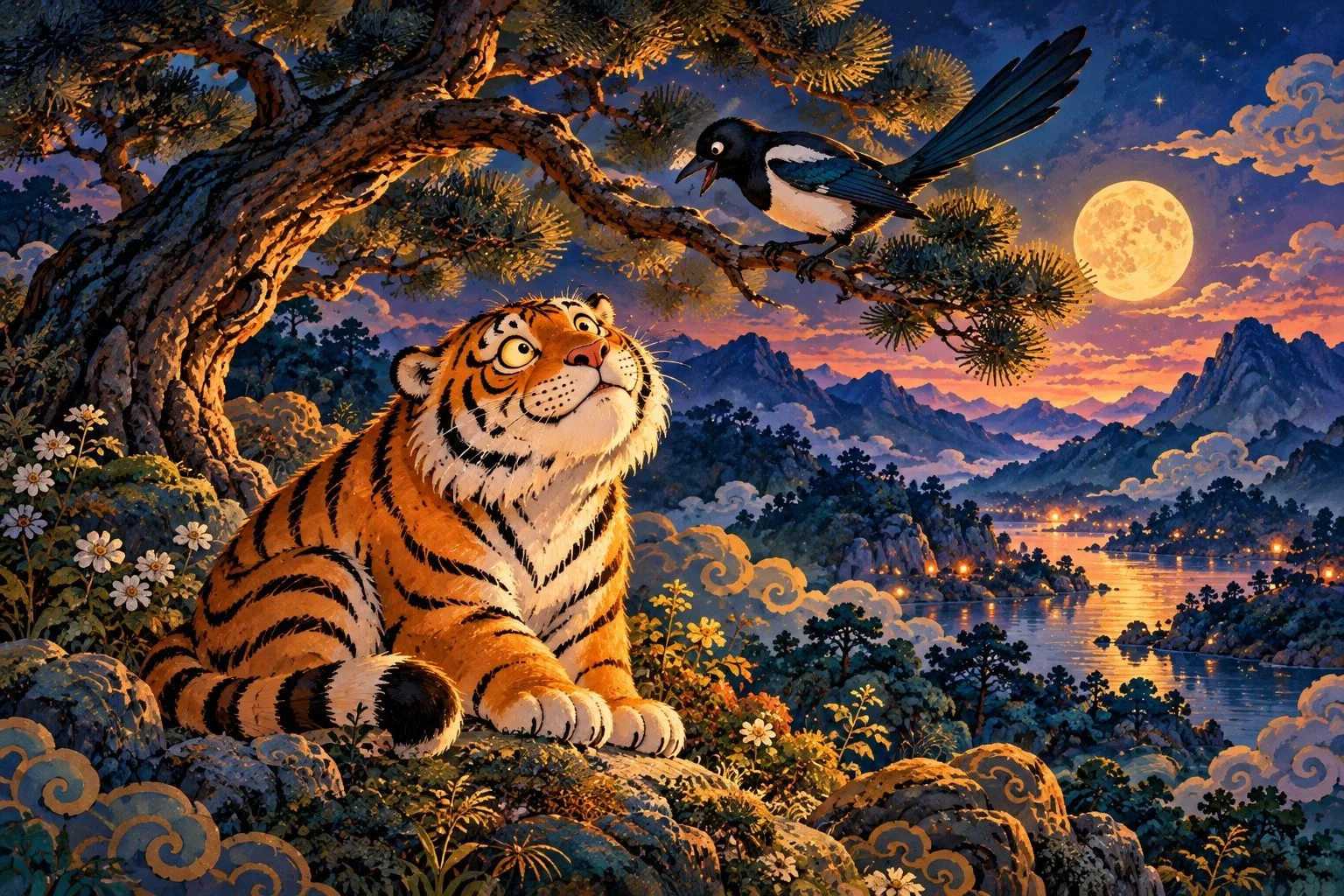
Of all the images in Korean folk art, one is instantly recognisable. A big striped tiger sits under a pine tree. He should be terrifying, but he isn’t. His eyes are round and goggling, sometimes crossed, his mouth hangs open in a foolish grin, and his tail curls about like a question mark. Above him, on a pine branch, sits a small black-and-white magpie, looking down at him with complete confidence, perhaps chattering away. The tiger looks back up, a little lost.
This is the kkachi horangi (까치호랑이), the “magpie and tiger”, known in more formal language as jakhodo (작호도). It was painted again and again by Joseon-era folk painters, and today it appears on everything from museum walls to souvenirs. It is cheerful, lucky and, if you know how to read it, quietly funny.
Two lucky animals
The Encyclopedia of Korean Culture explains that each animal had its own original meaning. The tiger was a guardian against misfortune, the most fearsome animal there was, and so able to frighten away bad luck and evil. The magpie was a bird of good news. In Korean folk belief, a magpie chattering in the morning means a visitor is coming or good news is on its way.
Put them together, and the painting worked as a kind of double blessing: one animal to keep trouble out, and one to bring happiness in. That is why such pictures were hung in homes, especially at the start of a new year.
Pictures on the gate
The encyclopedia notes that the tiger-and-magpie painting was often paired with a picture of a dragon among clouds, and that this pairing comes from an older custom. On the first day of the lunar new year, families pasted pictures of a dragon and a tiger on the two halves of their front gate. The tiger, the saying went, “chases away the three calamities”, while the dragon “brings the five blessings”. The tiger was the guard, the dragon the bringer of good fortune.
In this sense, the tiger picture was a talisman made of paint. The encyclopedia’s entry on talismans makes the same point: because the tiger was the most frightening animal, its image was believed to block bad luck.
Read about bujeok, Korean talismans →
The joke inside the painting
Over time, folk painters turned the picture into something more than a lucky charm. The encyclopedia explains that the relationship between the tiger and the magpie became a little story. In many folk versions, the tiger stands for powerful people, like corrupt officials, and the magpie stands for ordinary folk. The tiger is painted as a bit of a fool, while the magpie is bold and self-assured, and the mighty beast seems flustered and helpless in front of the little bird.
In a society with strict ranks, where ordinary people could rarely say what they thought of those above them, the painting let them laugh at power. The encyclopedia describes it as an allegorical, satirical take on the tensions between classes, and says that this extra layer gave viewers a sense of release. The great lord of the mountains is reduced to a goggling, puzzled pussycat, while the commoner magpie has the last word.
From China to Korea
The theme did not start in Korea. Paintings of tigers with magpies go back to Chinese pictures of the Yuan and Ming dynasties, such as images of a mother tiger with her cubs, and the encyclopedia says this kind of painting reached Korea from Ming China around the time of the Japanese invasions of the 1590s. Those Chinese tigers were painted realistically, their fur soft and detailed as a mink blanket, with lifelike pines and birds.
From the seventeenth century, Korean painters began to change the style, flattening the forms and making the brushwork bolder and more expressive. In the hands of anonymous folk painters, the tiger became more and more playful, until the theme was, in the encyclopedia’s words, so completely Koreanised and popularised that it came to represent Korean folk painting as a whole. Famous examples are held by the Leeum Museum in Seoul and by several museums of folk art in Japan.
The tiger and the magpie today
The tiger’s friendly folk-painting face has had a remarkable modern career. The encyclopedia notes that when Seoul hosted the 1988 Olympic Games, the tiger from the magpie-and-tiger painting was chosen as the character to represent Korea. The goofy, good-natured tiger, it turned out, was exactly how Korea wanted to introduce itself to the world.
You will find the same tiger lounging beside the mountain god in temple paintings, where, as another encyclopedia entry puts it, the king of beasts looks as cute and playful as a cat.
Meet the tiger of Korean folklore →
Meet Sansin, the mountain god →
Quick facts
The kkachi horangi, or tiger-and-magpie painting, is the best-known theme in Korean folk painting. The tiger guards against misfortune and the magpie brings good news, so the painting was a lucky charm, often hung at the new year and paired with a dragon. Folk painters made the tiger goofy and the magpie bold, a gentle joke about the powerful and ordinary people. The theme came from Ming China around the 1590s and became thoroughly Korean, and its tiger inspired the 1988 Seoul Olympics mascot.