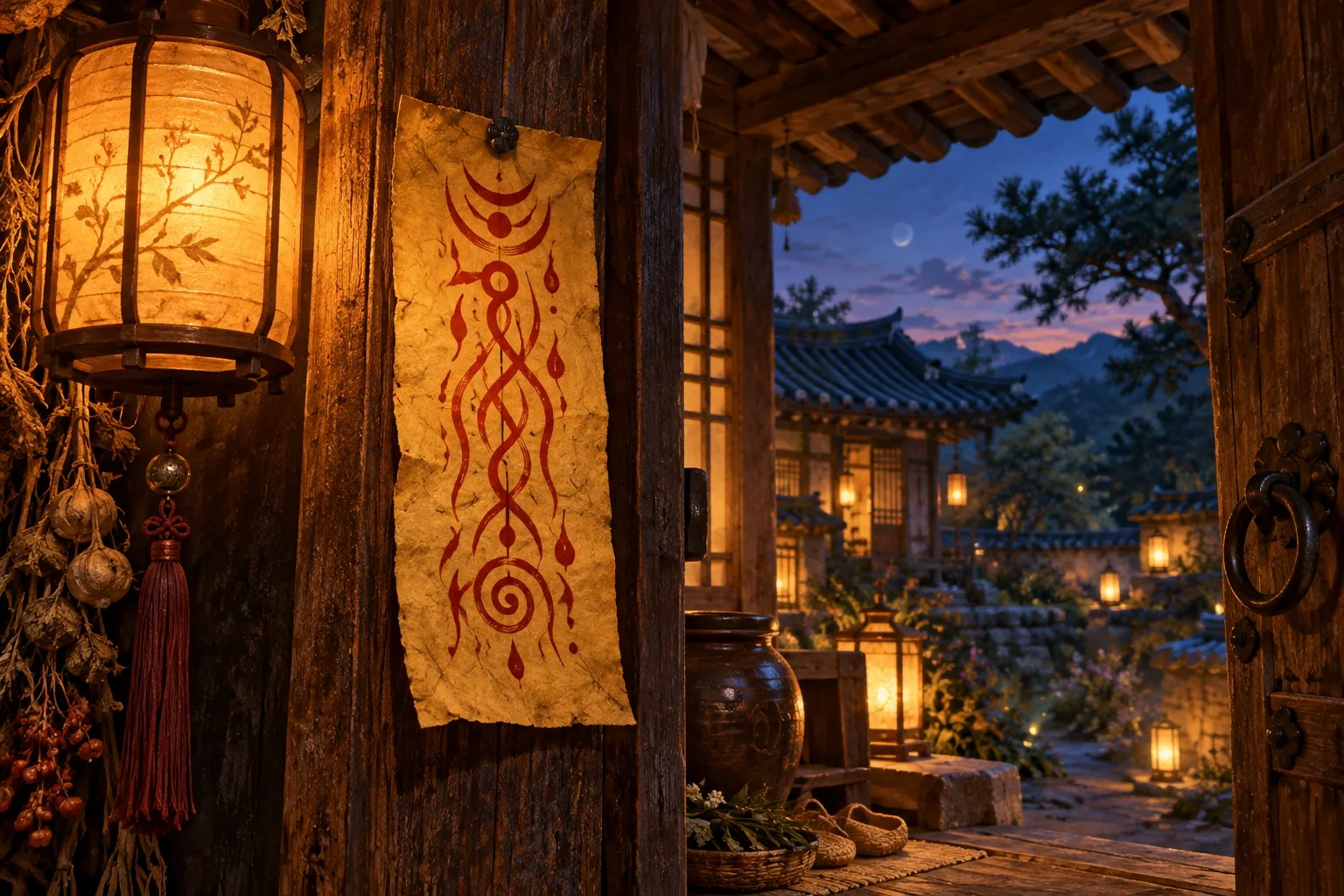
In Korean horror films, there is one prop that always means trouble is coming: a strip of yellow paper covered in swirling red marks, slapped onto a door or a coffin to hold back something that wants to get in. That paper is a bujeok (부적), a Korean talisman. But bujeok are not only for ghost stories. For centuries, Koreans have pinned them above doorways, folded them into pockets and wallets and even burned them and drunk the ashes, hoping for health, luck, children, success in exams and protection from evil.
What is a bujeok?
The Encyclopedia of Korean Culture defines bujeok as paper on which writing, pictures or symbols are drawn, believed to drive away evil spirits and bring good fortune. They come in two broad kinds. Some use magical power to increase something good: long life, wealth, children, an official post, passing an exam, or peace at home. Others work by driving away something bad: misfortune, impurity, ghosts and demons. The encyclopedia notes that the second kind is the more common.
There are bujeok for almost everything. The most common of all, the encyclopedia says, are talismans against illness, with special ones for headaches, stomach aches, colds, sore throats, eye and ear trouble, and even tiredness and poor appetite. Others protect against the “three calamities” known as samjae, against wild animals, or against nightmares, while others promise harmony between husband and wife.
Why yellow and red?
The classic bujeok is drawn in red on yellow paper, and the colours have meaning. The encyclopedia explains that yellow stands for light, which evil spirits hate above all, which is also why characters such as “sun”, “moon” and “light” appear so often on talismans. Red is the colour of blood and fire, of life and strong feeling, and fire has the power to purify, so red is thought to drive evil away.
Traditionally the red ink was made from finely ground cinnabar, a red mineral, mixed with oil or sugared water, and the paper was dyed yellow with the fruit of the pagoda tree. A talisman was supposed to be small, no more than about ten by fifteen centimetres.
How a bujeok was made
A bujeok was not simply scribbled down. According to folk belief, both the person making it and the person who would use it had to be pure in heart. The encyclopedia describes the traditional process. A lucky day was chosen according to the user’s age. The day before, both people bathed and avoided anything unclean. On the morning itself, the maker rose early, washed, put on clean clothes, faced east, set out a bowl of fresh water, burned incense, clicked their teeth together three times and recited an incantation. Then the talisman was drawn, in one unbroken burst of concentration.
Bujeok can be pictures, writing or a mixture. Some show birds, fish, the sun, human figures or goblin faces. Others are built from Chinese characters broken apart and recombined with lines and loops, often under the heading chingnyeong, “by imperial command”, as if a powerful god were ordering the demons to flee or holding them bound. Many are deliberately mysterious. The encyclopedia notes that part of a talisman’s power was thought to lie in not revealing its meaning, and that a maze-like spiral pattern appears in many Korean bujeok.
Older than paper
The idea behind bujeok is very old. The encyclopedia points to two Silla stories in the Samguk Yusa. In one, a half-spirit named Bihyeong commanded the ghosts of the capital, and people wrote a verse about him and pasted it up so that wandering spirits would stay away. In the other, a mysterious man named Cheoyong charmed a demon of disease with song and dance, and the demon promised never to enter any house with Cheoyong’s picture on the gate. Both, the encyclopedia says, work just like a talisman: words or pictures with the power to keep evil out.
The tiger, too, was a kind of living talisman. Because it was the most fearsome animal of all, people believed its image could block misfortune, and tiger pictures were pasted on gates at the new year.
See the tiger and magpie folk painting →
Bujeok and Korean ghosts
Bujeok take their place among the many things Korean tradition used against harmful spirits. Alongside fire, salt, red beans, peach-wood branches and red earth, the encyclopedia lists written talismans as one of the main weapons against ghosts.
Meet the gwisin, the ghosts of Korea →
Bujeok are still made today, and some people keep one tucked in a wallet, half in earnest and half for luck. And on screen, the yellow paper with its red marks has become one of the most recognisable symbols of Korean supernatural stories.
Quick facts
A bujeok is a Korean paper talisman drawn with writing, pictures or symbols, believed to drive off evil and bring good luck. Traditionally they are drawn in red cinnabar on yellow paper, because evil is thought to hate light and to fear fire. Bujeok exist for health, wealth, children, exams and protection from ghosts and calamities, and were pinned above doors, carried, or burned and drunk. The idea goes back to Silla stories of verses and pictures that kept demons away.