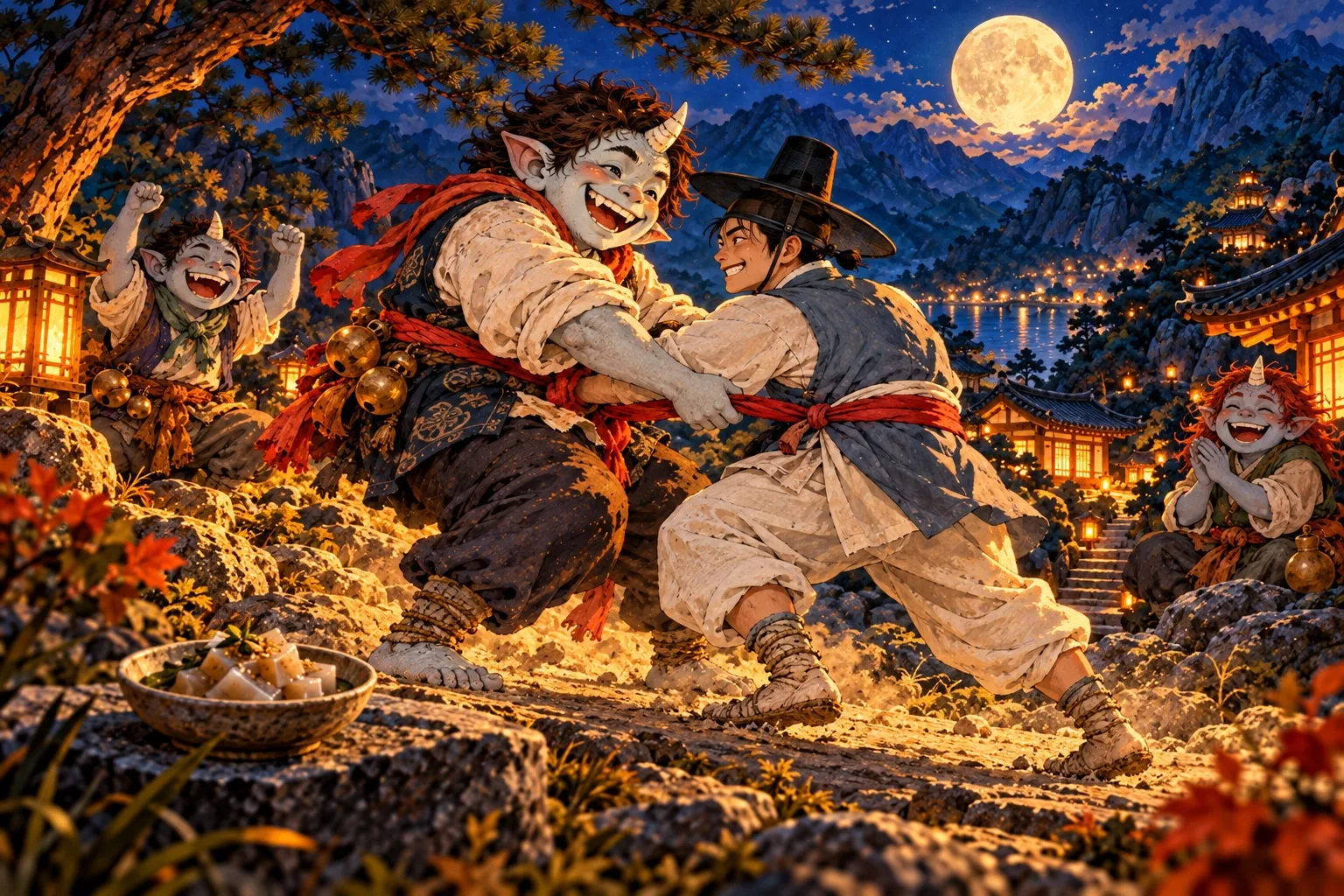
Every culture has its goblins, and Korea’s are called dokkaebi (도깨비). They are not ghosts and they are not quite gods. They are mischievous, larger-than-life spirits who appear at night, love music and wrestling and food, and can’t resist a game. They play tricks on people, but they are also famously easy to trick, and in the old stories a clever or lucky human who crosses paths with a dokkaebi might walk away with a fortune. Of all the creatures in Korean folklore, they are the most fun.
Where do dokkaebi come from?
The most surprising thing about dokkaebi is their origin. Unlike ghosts, which are the spirits of people who have died, dokkaebi are usually born from things. According to the Encyclopedia of Korean Culture, Korean folk belief held that natural objects, and especially everyday objects that people had used for a long time, could turn into dokkaebi. The list is wonderfully ordinary: a worn-out broom, a fire-poker, a straw sandal, a mortar pestle, a sieve, a winnowing basket, a cooking pot, a cracked bowl, a cushion. Objects that had soaked up the touch of human hands, or a woman’s blood, were said to be especially likely to come alive.
That idea explains a lot about dokkaebi. They are creatures of the household and the village, made from the stuff of daily life, which is why they behave so much like people: they want to eat, drink, dance and show off. Many Korean tales end with a terrifying dokkaebi that has been wrestled to the ground all night, only to be found at dawn as nothing more than an old broom handle lying in the road.
Dokkaebi are old. The Samguk Yusa, a thirteenth-century collection of Korean history and legend, includes stories about spirits of this kind from the Three Kingdoms period, among them the tale of Bihyeong, a Silla prince said to command a crowd of spirits who built a bridge for him in a single night. Later Korean scholars described dokkaebi as the gathered energies of mountains and seas, or the spirits of grass, trees, earth and stone.
What do they look like?
Old Korean sources don’t agree on a single look, and that is part of the point. Some dokkaebi are invisible, and you only know they are near from strange sounds in the night: dishes breaking in an empty kitchen, horses’ hooves on a deserted road, roof tiles rattling. Visible dokkaebi come in every shape. Folk accounts describe them with wild, tangled hair, or hopping about on a single leg, or so enormously tall that their heads disappear into the clouds. They can take the shape of a child, an old man, a young bachelor or a pretty girl. Some turn into a floating lantern, a rolling egg, a straw mat or a bedsheet that flaps toward you down a dark lane.
The image most people know today, a stocky, grinning figure with a horn on its head and a spiked club in its hand, is much more recent. Many Korean folklorists point out that this look closely resembles the Japanese oni, and argue that it entered Korean picture books and school readers in the early twentieth century, during the period of Japanese rule. The older, shape-changing dokkaebi of village storytelling had no fixed costume at all. Modern Korean artists have been experimenting ever since with ways to give dokkaebi a look that is more their own.
Habits and favourite things
Whatever their shape, dokkaebi share a personality. They come out at night, or on gloomy, drizzly, foggy days, and they vanish when the cock crows at dawn. They haunt mountain paths, valleys, fields, old temples and abandoned houses, the kind of places where a lone traveller might be walking home late.
They love to play, and above all they love to wrestle. A classic dokkaebi encounter begins with a voice in the dark challenging a passer-by to a bout of ssireum, Korean wrestling, and the dokkaebi will keep going all night, even on one leg, until somebody wins. They love music and dancing, and they love food: buckwheat jelly, memilmuk, is said to be their favourite on the mainland. On Jeju Island the local dokkaebi, called Yeonggam (“old master”), is said to have a weakness for pork, millet porridge, strong liquor and pretty women.
Dokkaebi are also, in their way, honourable. In one well-known story a man lends a dokkaebi some money, and the dokkaebi, who has a very bad memory, comes back every single evening to repay the same loan, over and over again, until the man is rich. They are not very bright, they are easily frightened, and they cannot stand being made fools of, so a dokkaebi that thinks it has been cheated will take its revenge. But they are not vicious. The Encyclopedia of Korean Culture sums up the difference neatly: a ghost might kill you, but a dokkaebi only plays pranks.
Dokkaebi and wealth
The most famous thing about dokkaebi is that they can make people rich. Their magic club, the dokkaebi bangmangi, can conjure gold, silver or food with a tap and a shout of “ttukttak!” In some stories they own other treasures too, such as a magic hat that makes its wearer invisible.
In the folktales, humans usually get hold of this wealth by accident or by a trick. A kind boy hiding in the rafters cracks a hazelnut, and the goblins flee in panic, leaving their club behind. An old man with a lump on his face sings so beautifully that the dokkaebi offer to buy the “song bag” they believe is inside the lump, and take it away in exchange for treasure. In both cases a greedy neighbour tries to copy the trick and comes home with a beating, a long nose, or a second lump. Those stories are among the best-loved in Korea, and they say as much about human greed as about goblins.
Read The Hazelnut and the Dokkaebi’s Magic Club →
Dokkaebi fire and dokkaebi belief
Dokkaebi were not only characters in stories. People in many parts of Korea took them seriously as spirits. Strange lights flickering over marshes and fields at night were called dokkaebibul, dokkaebi fire. Farmers watched for it around the first full moon of the lunar new year, and believed that if the lights travelled from east to west, the coming harvest would be good, and if they moved from west to east, there would be famine.
In fishing villages, especially on Korea’s southwest coast and on Jeju, dokkaebi were treated as spirits who could bring a good catch, and families held small rites to honour them. Blacksmiths, who worked with fire, sometimes honoured dokkaebi too. On Jeju, the dokkaebi became a guardian of households, boats and villages, and shamans performed a ritual called Yeonggam nori, “playing for the old master”, to drive away illnesses the dokkaebi were thought to cause, with food, drink and a lot of noise.
Scholars note that the dokkaebi’s sacred side faded over time. In legends they still kept some of their power, but in the folktales they became more and more comic, the bumbling party-goers of the hazelnut story rather than spirits to be feared.
Dokkaebi today
Dokkaebi are everywhere in modern Korea. They appear in children’s books and cartoons, in festivals, on souvenirs and in advertising, and the expression “dokkaebi bangmangi” is still used for any magical shortcut to wealth. The hit 2016 drama Guardian: The Lonely and Great God was known in Korean simply as Dokkaebi, although its immortal hero has little in common with the wrestling, jelly-loving goblins of the old tales. Whatever shape they take, dokkaebi remain Korea’s favourite reminder that the world is full of mischief, and that a little cleverness can turn a fright into a fortune.
Quick facts
Dokkaebi are Korean goblin spirits, usually said to be born from old household objects or natural things rather than from the dead. They appear at night and vanish at cockcrow, love wrestling, music, feasting and buckwheat jelly, and are easily fooled. Their magic club can conjure riches. Dokkaebi fire was read as a sign of the coming harvest, and in fishing villages and on Jeju dokkaebi were honoured as spirits of good fortune.
Meet the gumiho, the nine-tailed fox →