Long ago there lived a scholar named Shim Hak-gyu and his good wife, Lady Gwak. They were poor, and they had no children. After many years of prayer, Lady Gwak dreamed a wonderful dream, and soon she gave birth to a daughter. They named her Cheong. But the joy did not last. Within days of the birth, Lady Gwak fell ill and died, and Shim, who had already lost his sight, was left alone in the dark with a newborn baby.
He did the only thing he could. He wrapped his daughter in a blanket and went from house to house in the village, feeling his way along the walls, begging the young mothers to spare a little milk for her. They were moved by the sight of the blind man and his hungry child, and they fed her, and so Cheong lived.
Day after day he made the same rounds, in rain and snow, with the baby tucked inside his coat to keep her warm. He learned which houses had new babies, and which doors would open, and which dogs would bark. People in the village said they had never seen a father love a child so much.
She grew up to be the kindest, cleverest girl in the village. When she was only seven or eight, she began to take care of her father instead of the other way round. She led him by the hand, cooked his rice and mended his clothes, and when she was a little older she worked in other people’s houses, sewing and pounding grain, to earn enough for them both to eat.
In the evenings she sat beside him and described the world to him: the colour of the sunset, the shape of the clouds, the faces of the neighbours. Shim would listen with his head tilted and his blind eyes half closed, smiling, and say that she painted pictures better than any artist.
Three hundred sacks of rice
One winter evening, when Cheong was late coming home from work, her father grew worried and went out to meet her. Tapping his way along the path, he slipped and fell into a deep, icy ditch. He was struggling in the freezing water, calling for help, when a monk passing by on his way back to his temple heard him and pulled him out.
The monk looked at the shivering blind man with pity. “If you were to give three hundred sacks of rice to the Buddha at our temple,” he said, “your eyes would open, and you would see the world again.”
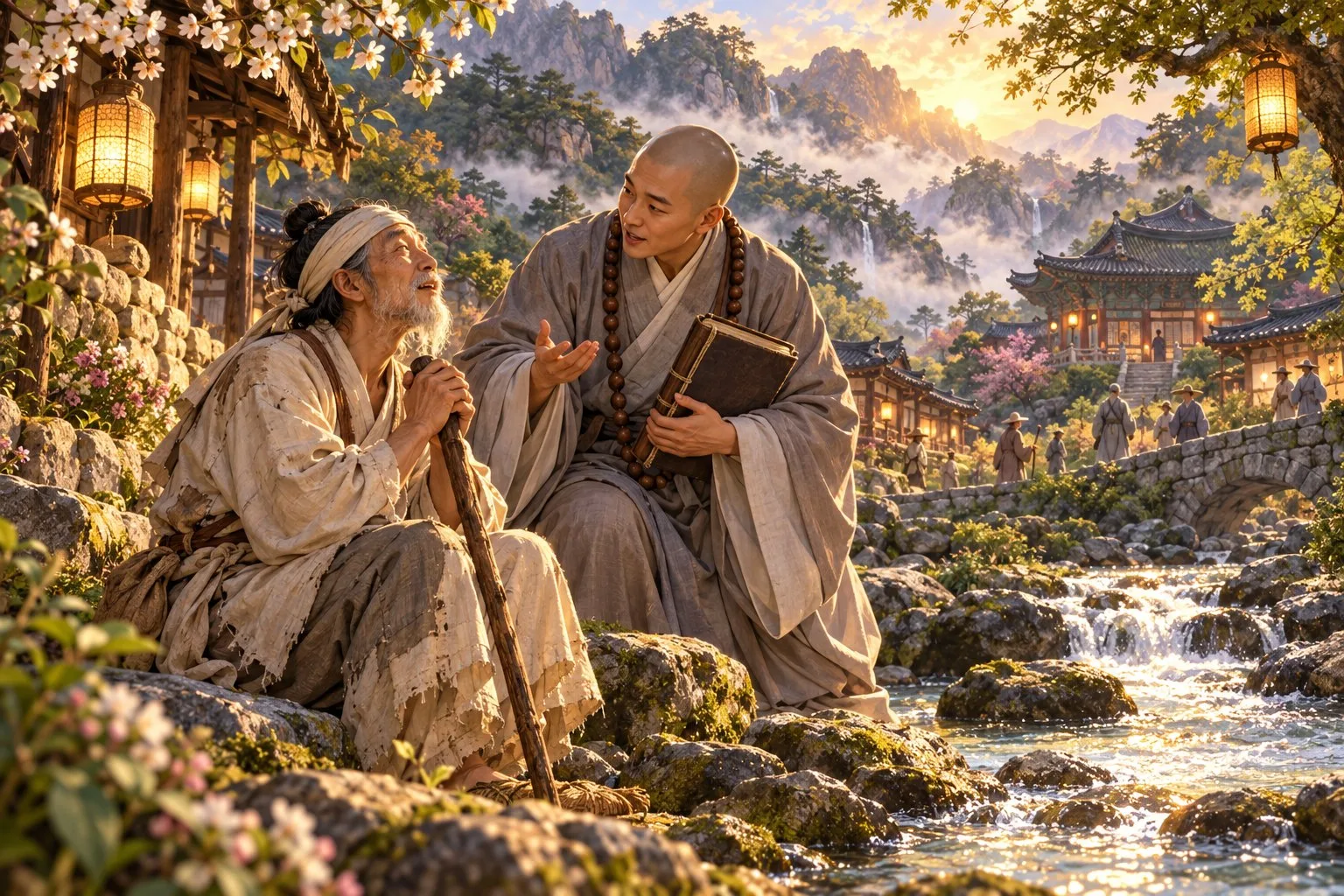
Shim was so overjoyed at the thought of seeing that he did not stop to think. “I’ll give it!” he cried. “Write my name down. Three hundred sacks!” The monk wrote it in his book and went on his way.
Only when he was home again did Shim realise what he had done. He and his daughter did not have three hundred grains of rice, let alone three hundred sacks. And a promise made to the Buddha could not be broken. He sat in the dark and wept.
He sat by the cold stove, wet and shivering, turning it over and over in his mind. What had he been thinking? How could a blind beggar give three hundred sacks of anything?
When Cheong came home and heard what had happened, she did not scold him. She comforted him, and that night, when he was asleep, she went out into the yard, set out a bowl of clean water and prayed to heaven and earth to show her a way.
The sailors from the south
A few days later, word went round the village. A group of merchants from Nanjing had come looking for something strange: a girl of fifteen whom they could buy. Their ships had to pass a dangerous stretch of sea called Indangsu, where the waves were wild and many vessels had been lost, and they believed the sea would only grant them safe passage if they offered it a young girl.
Cheong went to the merchants. “I will go,” she said. “My price is three hundred sacks of rice.”
She did not tell anyone where she was going. She simply put on her cleanest clothes, combed her hair, and walked down to the harbour where the merchants’ ships lay at anchor, their great sails furled.
The merchants agreed. The rice was sent to the temple, and the day of sailing was fixed. Only then did Cheong tell her father the truth. Shim howled with grief and clung to her, begging her not to go, crying that he would rather stay blind for ever than lose her. The merchants who saw it were so moved that they gave the old man extra rice and money to live on.
Cheong bowed to her father one last time and walked down to the ships.
She did not look back, because she knew that if she did, she would not be able to keep walking. Behind her she could hear her father calling her name, again and again, until his voice was lost in the noise of the harbour.
The lotus flower
The ships sailed out to Indangsu. The sky turned black, the wind howled and the waves rose like mountains. The sailors made their offerings and prayed. Then Cheong, dressed in white, stood at the prow, covered her face with her skirt and, thinking of her father, threw herself into the sea.
At once the wind dropped and the waves fell still.
The sailors stood at the rail staring at the place where she had disappeared. Some of them wept. None of them spoke. The ships sailed on over a sea as smooth as glass.
But Cheong did not die. As she sank, the handmaidens of the Dragon King of the Eastern Sea caught her and carried her down to the Dragon Palace, where she was welcomed with honour and given medicine to revive her. Heaven, the Dragon King told her, had seen her devotion and would not let her story end there. He placed her inside an enormous lotus flower and sent her back up to the surface.
Months later, when the merchants sailed back over Indangsu, they found a huge, beautiful lotus floating on the calm water. Astonished, they lifted it into their ship and presented it to their king. When the flower opened, Shim Cheong stepped out. The king fell in love with her, and she became his queen.
The feast for the blind
Queen Cheong had everything a person could want, except the one thing she wanted most. She could not stop thinking about her father. So she asked the king to hold a great feast and invite every blind person in the land, hoping her father would come.
For days the blind men and women arrived at the palace, and for days she searched their faces. On the very last day, the very last guest came stumbling in, ragged and thin. It was Shim Hak-gyu.
When he heard that the queen had sent for him, and then heard her voice calling “Father!”, he could not believe it. “Cheong? My Cheong is dead,” he cried. “Is it really you? Let me see you, let me see you!” And in that moment of longing, his eyes flew open. For the first time in his life, Shim saw his daughter’s face.
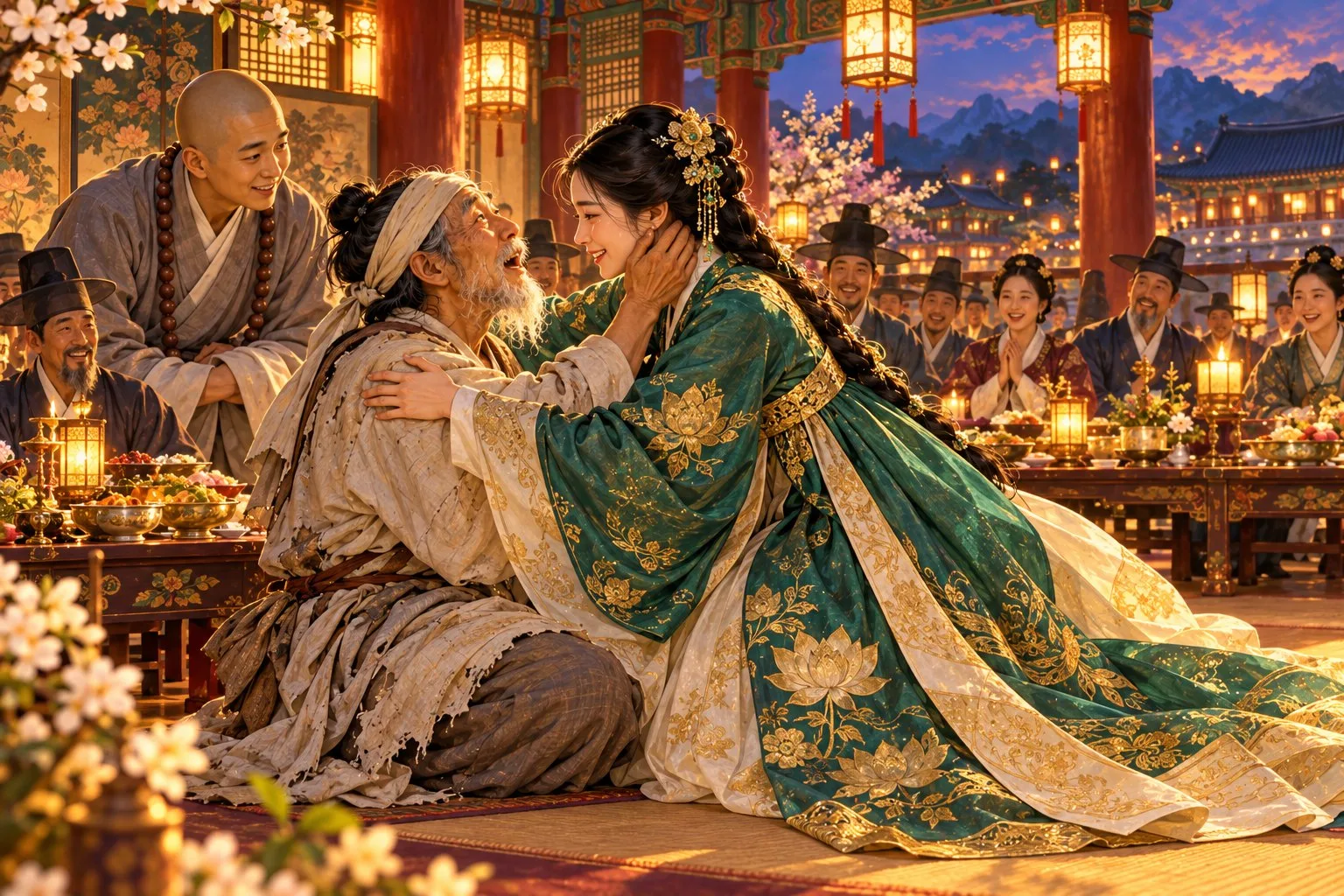
In some tellings, every blind guest at the feast opened their eyes at the same moment. And Shim and his daughter lived out their days together in happiness.
The story in song
Simcheongga, the pansori version, is one of the five great pansori still performed today. A single singer, accompanied by a drummer, performs every character, from the grieving father to the roaring sea, over several hours. The scene of Shim Cheong’s farewell and the moment her father’s eyes open are among the most famous passages in all of Korean music.
Talk about it
Was Shim Cheong right to sacrifice herself, or should someone have stopped her? Who is responsible for what happened: the father, the monk, the merchants? And why do you think the storytellers brought her back to life?
Words to know
Hyo (효) is devotion and duty to one’s parents. Gongyangmi (공양미) is rice offered to the Buddha. Indangsu (인당수) is the stormy sea where Shim Cheong is offered. Pansori (판소리) is the Korean art of epic storytelling in song.
Where this story comes from
Simcheong jeon (심청전, The Tale of Shim Cheong) is a classic Korean novel by an unknown author, and was also sung as one of the great pansori, Simcheongga. The Encyclopedia of Korean Culture notes that more than 230 versions survive, and that records of professional storytellers reading it aloud show it was already complete and popular by the eighteenth century.
The versions fall into two main families. The Seoul woodblock editions (Gyeongpan) are simple, solemn and centred on Shim Cheong's devotion. The Jeonju woodblock editions (Wanpan), which grew out of pansori performance, add a crowd of extra characters, including a kindly noble lady who offers to adopt Shim Cheong and a scheming widow called Ppaengdeok-eomi who takes advantage of the blind father, along with much comedy. The retelling here keeps to the common outline. Scholars have proposed many possible roots for the tale, from a Silla story of a devoted daughter in the Samguk Sagi to Buddhist tales of children who save their parents and shaman songs about journeys to the other world. In 1912 the writer Yi Hae-jo rewrote it as a modern novel, Gangsangnyeon ("Lotus on the River"), and it has since been filmed, staged as opera and changgeuk, and reimagined by many modern writers.
What it means
Most Koreans would say the story is about hyo (효), devotion to one's parents, and that has long been the usual reading. But the Encyclopedia of Korean Culture shows how much more readers have found in it. Some focus on Shim Cheong's self-sacrifice: a daughter offering her own life to heal her father. Some read it as a Buddhist story of karma and rebirth, since in one version she learns she was once a dragon princess in a past life. Others point out that the three hundred sacks of rice given to the temple never actually cure anything, and read the story as quietly critical of the monk who asked for them.
Modern readers often ask harder questions. Why should a girl of fifteen have to die to fix her father's rash promise? Some scholars see the tale as exposing a system of values that pushed women towards death in the name of duty. The pansori versions also poke fun at the father, Shim the blind man, showing him as vain, careless and easily fooled. The story has lasted precisely because it can be read so many ways: as a celebration of love and duty, and as a story about what that duty cost.
Sources & further reading
Retold from the outline of Simcheong jeon in the Encyclopedia of Korean Culture entry "심청전", combining the shared plot of the Seoul and Jeonju editions. It is an English adaptation, not a translation.
- Encyclopedia of Korean Culture · 심청전 (The Tale of Shim Cheong) ↗
- Encyclopedia of Korean Culture · 용신신앙 (dragon god belief) ↗
Illustrations are imaginative interpretations, not historical records. Read our editorial policy.