Long, long ago, before there were any people on Jeju, before there was even a Jeju at all, there was only the wide grey sea, rolling on and on under the sky. And walking through that sea, with the waves lapping round her ankles, there was a grandmother so enormous that the clouds brushed her shoulders.
Her name was Seolmundae Halmang. Her hair streamed out behind her like a waterfall, and when she laughed, the sound rolled across the water like thunder. She had walked the oceans for longer than anyone could remember. And one day, standing in the middle of all that empty water, she decided that what this place needed was an island.
A skirtful of earth
She bent down, plunged her great hands into the sea, and scooped up earth from the bottom. It was dark and heavy and smelled of salt. She piled it into her skirt, holding the hem up in front of her like a basket, until the skirt bulged and sagged. Then she waded to the place she had chosen and began to pour.
Load after load she carried. She scooped and poured, scooped and poured, and slowly a shape began to rise out of the waves: a long, rounded island, lying in the sea like a sleeping animal.
The sea foamed around her knees. Seabirds circled her head and screamed. The sun rose and set and rose again, and still she worked, humming to herself, as patient as the tide.
But Seolmundae Halmang’s skirt was very old. She had worn it for longer than mountains have stood, and it was full of holes. As she walked back and forth with her loads of earth, little handfuls trickled out through the holes and dropped onto the ground below. She did not even notice. But each small heap of earth that fell became a small hill.
By the time she had finished, there were more than three hundred and sixty of these little hills scattered all over the island, some round, some long, some with hollows in the top like bowls. Jeju people call them oreum, and you can still climb them today. If you stand on top of one and look around, you can see dozens of others dotted across the land like the crumbs of some enormous meal.
Making the mountain
In the very middle of the island, Seolmundae Halmang emptied her skirt again and again, piling earth on earth until she had built a great mountain that rose up into the clouds. That was Hallasan, the highest mountain in South Korea.
She stepped back, put her hands on her hips, and looked at it.
“Hmm,” she said. The top was too sharp and pointed for her liking. It looked unfriendly, like a spear.
So she reached up, took hold of the peak, broke it off with her hands, and tossed it away. It flew through the air to the southwest and landed with a crash near the sea. There it became Sanbangsan, the lonely bell-shaped mountain that stands by itself near the coast and looks as if it does not quite belong where it is. That is because it doesn’t.
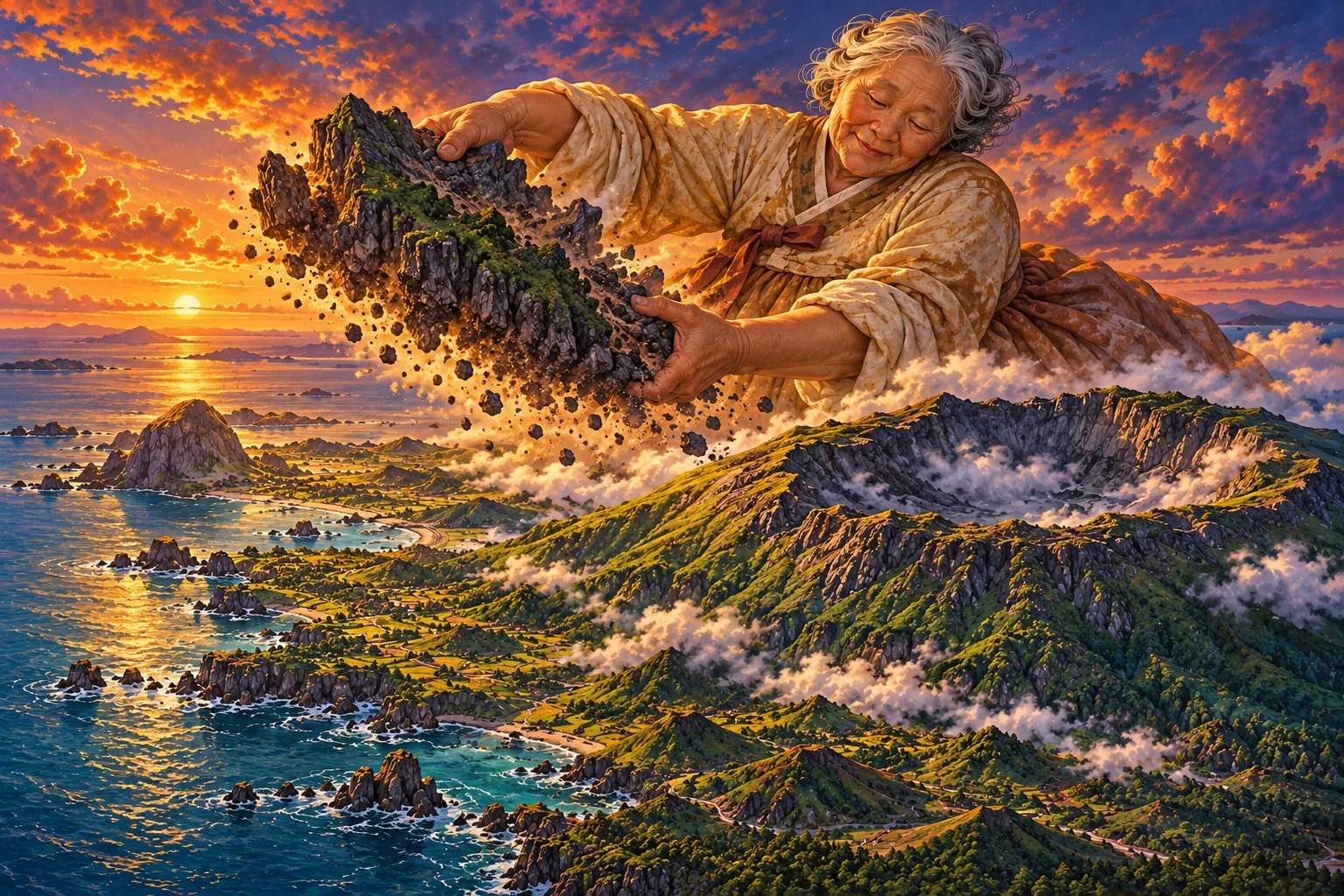
And where she had broken off the peak, a hollow was left on top of Hallasan. Rain filled it, and it became Baengnokdam, the crater lake on the summit. The name means “White Deer Lake”, because people say white deer used to come down from the sky to drink there.
Seolmundae Halmang was so tall that when she lay down to rest, she used Hallasan as her pillow, and her feet reached all the way to Gwantal Island, far out in the sea to the north. Once, half asleep, she stretched her legs carelessly and kicked a hole right through the island. When she sat sewing at night, mending her old skirt, she set her lamp on a stone pillar near Seongsan Ilchulbong, on the island’s eastern tip. People there still point out that rock and call it her lamp stand.
The bridge that was never finished
In time, people came to live on Jeju. They built houses of black volcanic stone, they fished the seas and farmed the rocky fields, and they loved their island. But it was lonely being so far out at sea. Reaching the mainland meant a long and dangerous voyage across rough water, and many boats that set out never came back.
Seolmundae Halmang heard them talking about it, and she had an idea.
“Listen,” she said to the islanders, and her voice boomed over the fields. “I have never in my whole life had a proper pair of underclothes. All I have is this old skirt, and it is nothing but holes. If you make me a set of underclothes, I will build you a bridge, all the way from here to the mainland.”
The islanders could hardly believe their luck. A bridge to the mainland! No more storms, no more shipwrecks. They agreed at once.
Old fishermen who had lost brothers and sons to the sea wept openly. Children ran from house to house shouting the news. That night there was singing in every village on the island.
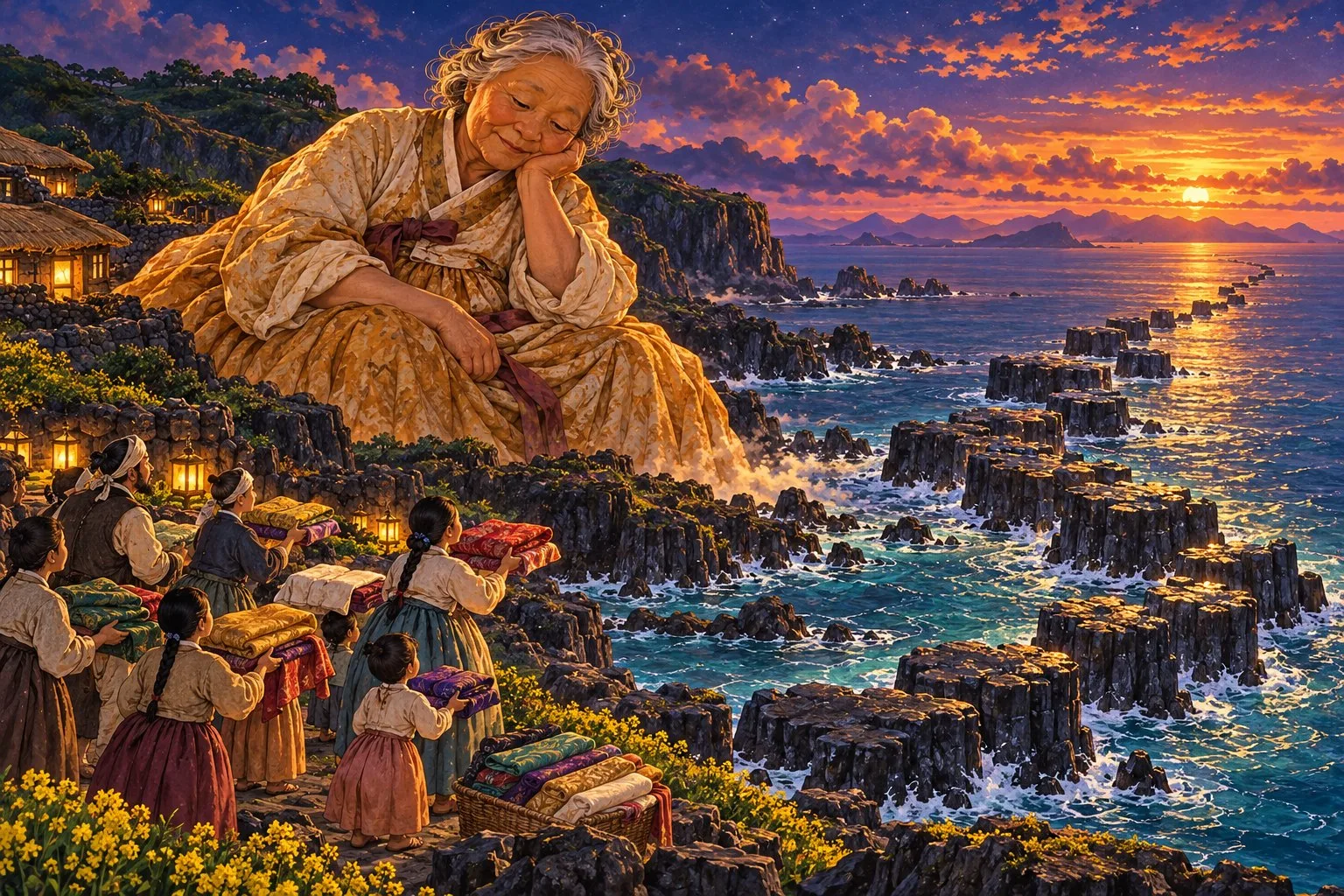
But they soon found that a woman as big as a mountain needs a great deal of cloth. The elders measured her and did their sums, and they worked out that the underclothes would take one hundred bolts of silk.
Silk was precious on Jeju. But every family on the island gave what they had. Women opened their wedding chests and took out the silk they had been saving for years. Old people brought out cloth they had kept for their funeral clothes. Everyone wove and gathered and searched in every chest and corner. At last they piled it all up in the village square and counted it.
Ninety-nine bolts.
They counted again. Ninety-nine. They searched the whole island one more time, house by house. There was not a single bolt more to be found. They were one short.
Without the hundredth bolt, the underclothes could not be finished. And without the underclothes, Seolmundae Halmang would not finish the bridge. She had already begun it, laying great rocks out into the sea from the north coast, and now she stopped where she was and would not lay another stone.
The bridge was never finished. People say you can still see where it began, a line of rocks running out into the water near Jocheon on the north coast, reaching toward the mainland and stopping in the middle of the sea.
How she died
Seolmundae Halmang was very proud of how tall she was. She liked to test it. Whenever she found a deep lake or pool, she would wade into it to see how far the water came up, and in every single one, it came no higher than her knees.
“The Yongyeon pool, they said, was bottomless,” she would laugh. “It barely wet my feet. Hongrimul was supposed to be deep. It didn’t reach my knees!”
Then one day she climbed up the slopes of Hallasan and came to Muljangori, a small, quiet lake hidden among the trees. It did not look like much. She stepped in, expecting the water to lap round her ankles as usual.
She was humming as she went, and the forest birds fell silent as her great shadow passed over them.
What she did not know was that Muljangori has no bottom.
She plunged straight down into the dark water and was never seen again.
The five hundred sons
Another story about her death is told just as often. In this one, Seolmundae Halmang had five hundred sons. One day, while she was cooking a vast pot of porridge for them, she slipped and fell into the pot. When her sons came home, they ate the porridge, and only when they reached the bottom did they discover what had happened. They were so overcome with grief that they turned to stone. They are the five hundred rock pillars of Yeongsil on Hallasan, called the Five Hundred Generals.
Talk about it
Why do you think the islanders came up exactly one bolt short? What would Jeju be like today if the bridge had been finished? Which ending for Seolmundae Halmang do you think is sadder?
Words to know
Halmang (할망) is the Jeju word for grandmother. Oreum (오름) are the small volcanic hills of Jeju. Hallasan (한라산) is Jeju’s great volcano. Baengnokdam (백록담) is the crater lake on its summit.
Where this story comes from
Seolmundae Halmang (설문대할망), "Grandmother Seolmundae", is the giant creator goddess of Jeju Island, off Korea's southern coast. The Encyclopedia of Korean Culture notes that she appears in old written records of Jeju, including a seventeenth-century gazetteer of the island and an eighteenth-century sea-travel diary, as well as in countless stories still told by islanders. Her name is spelled in many ways in the Jeju dialect, from Seonmundae to Semyeongju, and a shrine to her under one of those names stands at Dangke harbour in Pyoseon.
She is often compared to Mago Halmi, the giant grandmother of mainland Korean legend. Each story about her explains a piece of Jeju's landscape: the volcanic cone of Hallasan, the crater lake on its summit, the lone mountain of Sanbangsan and the hundreds of small volcanic hills called oreum that dot the island.
What it means
The Encyclopedia of Korean Culture explains that Seolmundae Halmang began as a true creation goddess, the maker of Jeju's land, and that over the centuries her holiness wore away. As the stories were retold, she became a figure in place-name legends and folk comedy, sometimes awesome and sometimes ridiculous. One telling has her drowning because she was too proud of her height; another has her falling into a pot of porridge.
Yet even in the funny stories, what she does is always connected to the shape of the island itself. Every hill, lake and rock she touched is still there for anyone to visit, which is part of why Jeju people have never stopped telling her story. Today she is honoured at Jeju Stone Park, which was built around her legend.
Sources & further reading
Retold from the episodes summarised in the Encyclopedia of Korean Culture entry "설문대할망 설화", with details from the entries on Hallasan and Baengnokdam. It is an English adaptation, not a translation.
- Encyclopedia of Korean Culture · 설문대할망 설화 (Seolmundae Halmang) ↗
- Encyclopedia of Korean Culture · 한라산 (Hallasan) ↗
- Encyclopedia of Korean Culture · 백록담 (Baengnokdam) ↗
Illustrations are imaginative interpretations, not historical records. Read our editorial policy.