Kim Seondal came from Pyongyang, and he was the cleverest man in the city. He had studied hard and passed the state examination, and he went down to Seoul sure that the government would give him an important post.
He waited. And waited. Other men, less clever than he was, were given positions all around him. When he asked why, the answer was always the same. He was from the northwest, and people from the northwest were not trusted with high office. And his family was not grand enough. No matter how talented he was, the door was closed.
He watched young men from grand Seoul families, who could barely write a decent poem, ride past him on horseback to take up their posts. He watched officials take bribes and call it gifts. He spent the last of his money on lodgings and waited outside government offices day after day, and day after day the clerks looked at his papers, saw where he came from, and put them at the bottom of the pile.
At last a kindly old clerk took pity on him. “Go home, young man,” he said quietly. “You could be the cleverest scholar in Joseon, and it would make no difference. They will never give a man from Pyongyang anything worth having.”
Kim Seondal sighed, packed his bag, and decided that if the powerful would not let him play by their rules, he would play by his own.
On the long road home to Pyongyang, he thought about it. The powerful made the rules, and the rules were made to keep people like him out. Very well. The powerful were also greedy, and vain, and very sure of their own cleverness. A man who understood that could have a great deal of fun with them.
A very expensive chicken
One day he was strolling through a market when he passed a stall selling chickens. In one of the cages was a particularly big, handsome rooster with glossy feathers. Kim Seondal stopped and stared at it with his mouth open, like a country bumpkin.
An idea had just hatched in his head, and he decided to play the fool.
“Excuse me,” he said to the chicken seller. “Is that a bong? A phoenix?”
He said it loudly, so that the people at the next stall turned to look. A few of them sniggered. Everyone knew that the phoenix was a bird of legend, a sign of heaven’s favour that appeared once in a thousand years, if it appeared at all.
“Of course not,” said the seller. “It’s a chicken.”
But Kim Seondal kept asking, looking more and more foolish. “Are you sure? It looks just like a phoenix. Isn’t it a phoenix?” At last the seller decided that if this idiot wanted a phoenix, he could have one, at a phoenix price.
“Yes, all right,” he said. “It’s a phoenix.”
“A real phoenix?” said Kim Seondal, clasping his hands. “Imagine that! A phoenix, right here in the market! How much do you want for it?”
The chicken seller named a price twenty times what any chicken was worth. Kim Seondal did not even haggle.
Kim Seondal paid a very high price for the rooster and carried it straight to the local magistrate. “Sir,” he said, bowing low, “I have brought you a phoenix as a gift.”
The magistrate looked at the chicken, turned purple, and had Kim Seondal beaten for making a fool of him.
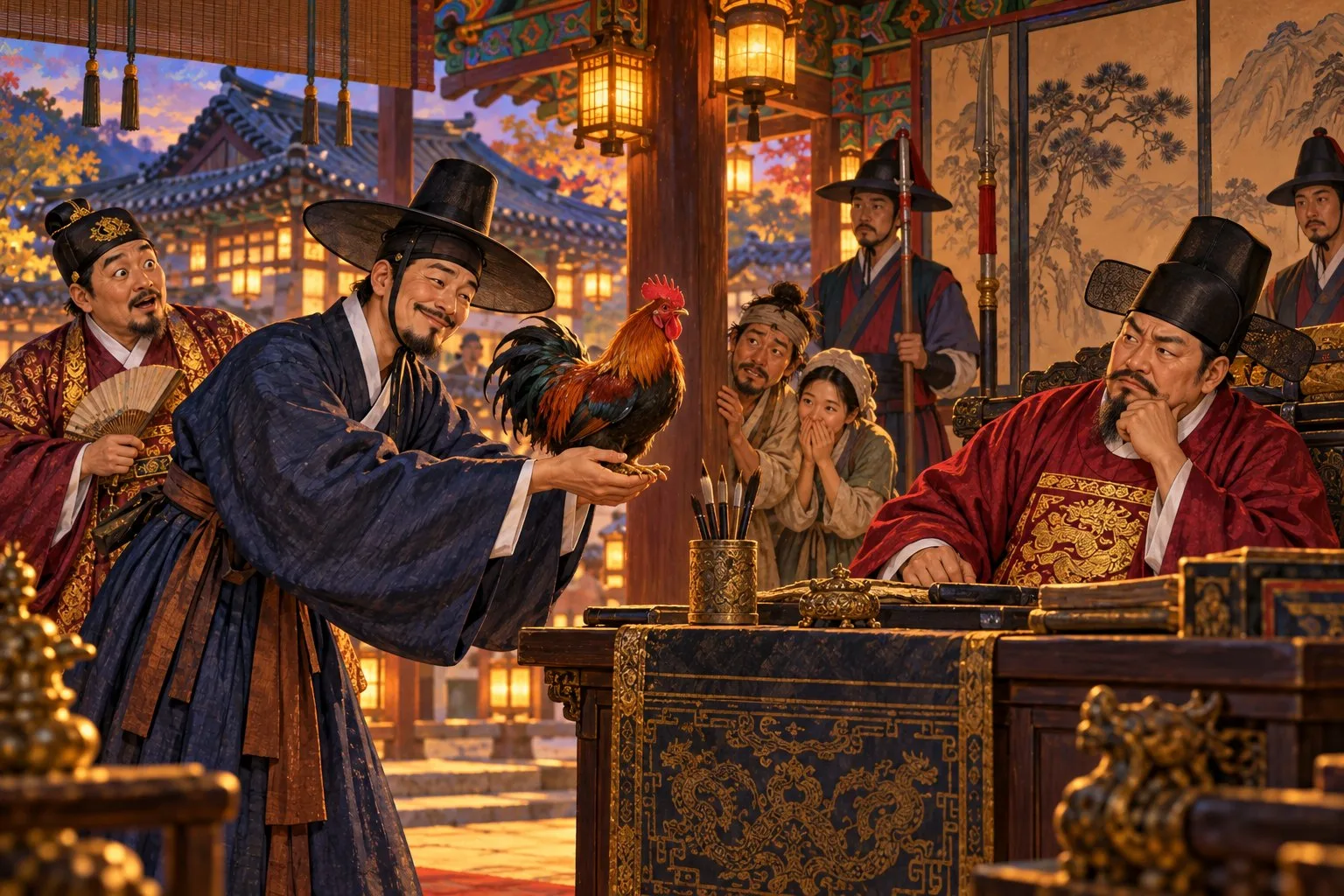
“A phoenix?” he roared. “That is a chicken! Do you take me for an idiot? Bring the rods!” And the guards dragged Kim Seondal out into the yard. Rubbing his sore backside, Kim Seondal explained, “But sir, I was only fooled myself! The chicken seller swore to me it was a phoenix!”
The magistrate summoned the chicken seller, who could hardly deny it. He was ordered to pay Kim Seondal back for the chicken, and for the beating too. Kim Seondal walked home with far more money than he had started with. From then on, everyone called him Bong-i Kim Seondal, “Phoenix” Kim Seondal.
The water carriers
But his greatest trick was yet to come.
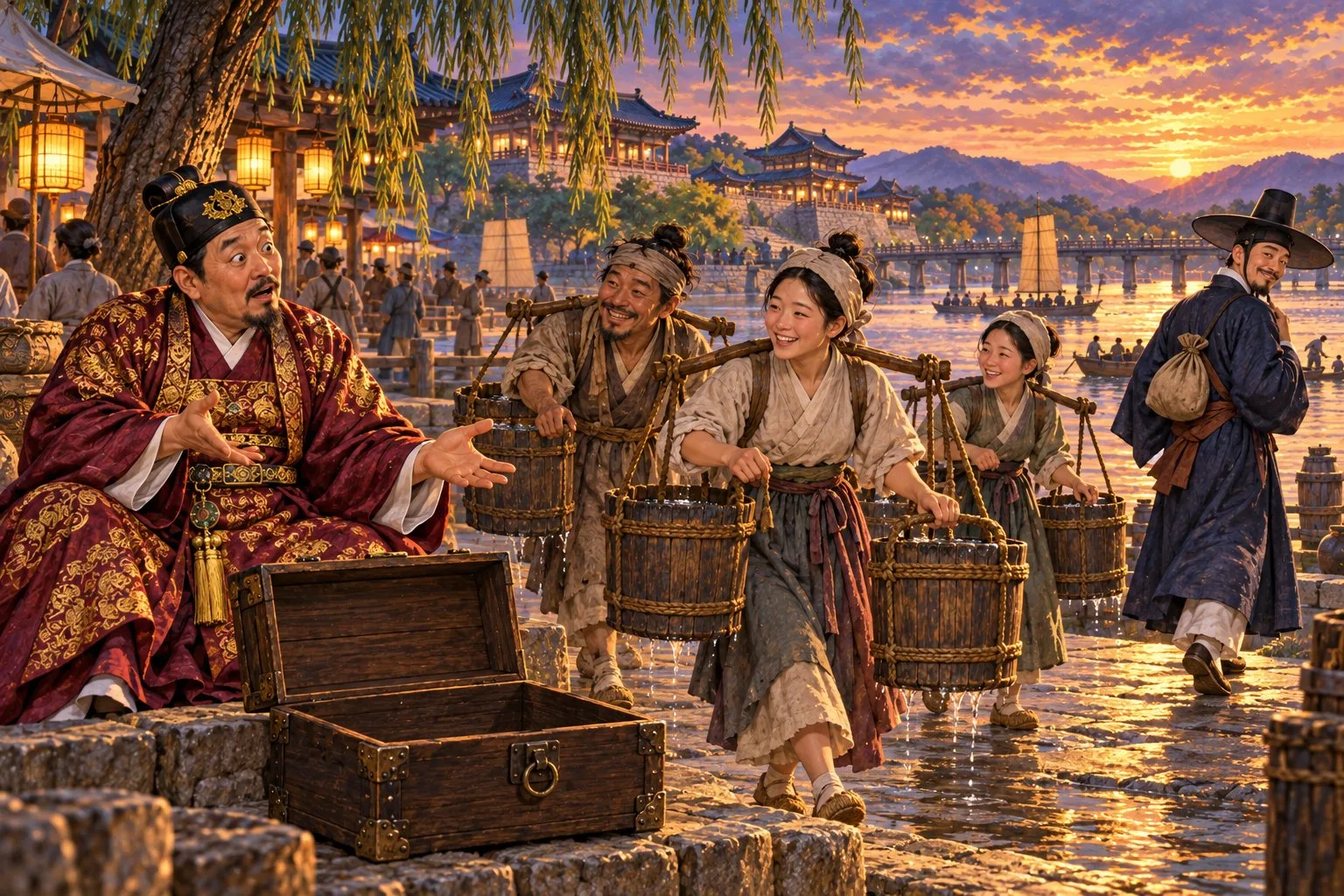
Every morning, the water carriers of Pyongyang went down to the Daedong River to fill their buckets and carry water to the houses of the city. One day Kim Seondal went down to the riverbank and gave each water carrier a coin.
The water carriers were poor men who worked from dawn until dark. They carried two buckets each on a wooden yoke across their shoulders, up and down the steep streets of the city, and were paid a few coppers for each load. They were not used to strangers handing them money.
“Here,” he said. “Tomorrow, when you come to fetch water, just give me this coin back. That’s all.”
The water carriers shrugged. It cost them nothing, so they agreed.
The next morning, Kim Seondal sat down on a stool by the river. One by one, the water carriers came, filled their buckets, and as they passed him, each one handed him a coin. Kim Seondal took the coins and dropped them into a box with a businesslike nod.
He wore his best coat and his tallest hat, and he had set up a little table beside him with a cash box and a ledger, just like a tax collector. He looked very important and a little bored, as if he had done this every morning for years.
Sometimes he frowned at a water carrier who was slow to pay, and the man hurried to hand over his coin. Sometimes he made a note in a little book. It looked exactly like a man collecting rent on his property.
Selling the Daedong River
A wealthy merchant from out of town was watching all this with great interest. He came over.
“Excuse me,” he said. “Why is everyone paying you?”
“Oh, that?” said Kim Seondal casually. “I own the water of the Daedong River. Anyone who takes water from it pays me. It’s a nice little business.”
The merchant’s eyes lit up. He watched the coins flowing into Kim Seondal’s box all morning and did some quick sums. Every day, hundreds of water carriers. Every year, thousands upon thousands of coins.
A river never runs dry. The money would keep flowing for ever, for him and his sons and his grandsons.
“Would you consider selling it?” he asked.
“Selling it?” Kim Seondal looked horrified. “My grandfather owned this river, and his grandfather before him. It is my family’s inheritance. What would my ancestors say?”
Kim Seondal pretended to be shocked. He said he couldn’t possibly. The merchant offered more. Kim Seondal shook his head. The merchant offered a great deal more. At last, with a heavy sigh, Kim Seondal agreed to sell him the right to the Daedong River’s water, and walked away with a fortune.
He even wrote out a proper contract, with the merchant’s name and his own and the words “the water of the Daedong River” in his finest calligraphy, and the merchant tucked it into his robe as carefully as if it were made of gold.
The next morning, the merchant sat down by the river with his box, ready to collect. The water carriers came, filled their buckets, and walked straight past him. When he demanded his money, they laughed in his face. Nobody owned the river. And by then Kim Seondal was long gone.
The merchant took his contract to the magistrate, who read it, and read it again, and then laughed until he cried. People in Pyongyang are still laughing about it today. Even now, when someone in Korea tries to sell something that isn’t theirs to sell, people say he is “selling the Daedong River like Kim Seondal”.
A trickster for a new age
Kim Seondal is one of a group of tricksters whose stories were popular in late Joseon, when markets and money were changing Korean life. The Encyclopedia of Korean Culture points out that his tricks are different from older folk pranks: he plans carefully and even spends his own money to set them up, just like an investor. His stories have been retold in open-air madang plays, films and webtoons, and his name has become shorthand in Korean for any outrageous swindle.
Talk about it
Is Kim Seondal a hero or a crook? Does it matter that he mostly tricks greedy or powerful people? Can you think of a modern “river” that someone might try to sell?
Words to know
Bong (봉) is a phoenix, short for bonghwang. Seondal (선달) was a man who had passed the state examination but had no post. Daedonggang (대동강) is the Daedong River, which flows through Pyongyang. Geondal (건달) is a word for a loafer or rogue.
Where this story comes from
Bong-i Kim Seondal (봉이 김선달) is the hero of a cycle of trickster stories from the late Joseon dynasty. The Encyclopedia of Korean Culture notes that these tales were first told in the northwestern provinces north of Kaesong and later spread across the whole country through collections of anecdotes. The first written version appears in a serialised story in the newspaper Hwangseong sinmun in 1906, which gives him the real name Kim Inhong, suggesting the tales were already widely known in the nineteenth century.
In the spoken stories he has no other name. Seondal was a title for a man who had passed the state examination but had not been given a post, and Bong-i is a nickname that comes from the most famous of his tricks.
What it means
The Encyclopedia of Korean Culture explains that Kim Seondal is one of several late-Joseon tricksters, along with figures such as Bang Hakjung and Jeong Manseo, whose stories reflect a changing society. In the legend, he is a talented man from Pyongyang who comes to Seoul hoping to make his mark, but is shut out because people from the northwest were discriminated against and his family was not grand enough. Frustrated, he sets out to make fools of arrogant nobles, rich merchants and hypocrites.
What makes him different from older folk tricksters is that his schemes are carefully planned and even need money invested up front. That makes him a new kind of hero for an age when trade and money were becoming more important. Today Koreans still call anyone who pulls off an outrageous con "a modern Bong-i Kim Seondal".
Sources & further reading
Retold from the two episodes described in the Encyclopedia of Korean Culture entry "봉이 김선달 설화". It is an English adaptation, not a translation.
Illustrations are imaginative interpretations, not historical records. Read our editorial policy.