On the banks of a northern river, long ago, the River Lord Habaek had three beautiful daughters. The eldest was called Yuhwa, Willow Flower. One day, while the sisters were playing by the water, a stranger came down from the sky. He was Haemosu, a son of heaven, and he and Yuhwa fell in love. But Haemosu soon returned to the heavens and did not come back, and Yuhwa's father was so angry that she had been courted without his blessing that he drove her out of his river.
She was found, alone and far from home, by Geumwa, the king of Buyeo. He took her back to his palace and kept her in a room by herself. And there a strange thing happened. Wherever she went in the room, a beam of sunlight followed her. She moved away from it, and it moved with her. Before long she was carrying a child. When the time came, she did not give birth to a baby. She laid an egg, enormous and pale, as big as a measure of rice.
She had wandered south for many days, through marsh and reed bed, until she came to the shores of a lake called Ubalsu. Fishermen there told their king that something strange was stealing the fish from their nets, and when the king’s men cast a great iron net into the water, they drew out a young woman sitting on a stone, so sad and so beautiful that they did not know what to make of her.
King Geumwa was horrified. “This is an evil omen,” he said. “Get rid of it.” His servants threw the egg to the dogs and pigs, but the animals would not eat it. They left it by the road, but cattle and horses stepped carefully around it. They carried it out into the open fields, and birds flew down and covered it with their wings to keep it warm. At last the king tried to smash it himself, but no matter how hard he struck, the shell would not break. In the end he gave it back to Yuhwa.
She wrapped the egg in soft cloth and kept it in a warm place, and one day the shell cracked, and out came a baby boy, bright-eyed and strong.
She sat beside it day and night. She talked to it and sang to it, the old songs of the river her father ruled, and sometimes she laid her hand on the shell and felt something stir inside.
The boy who never missed
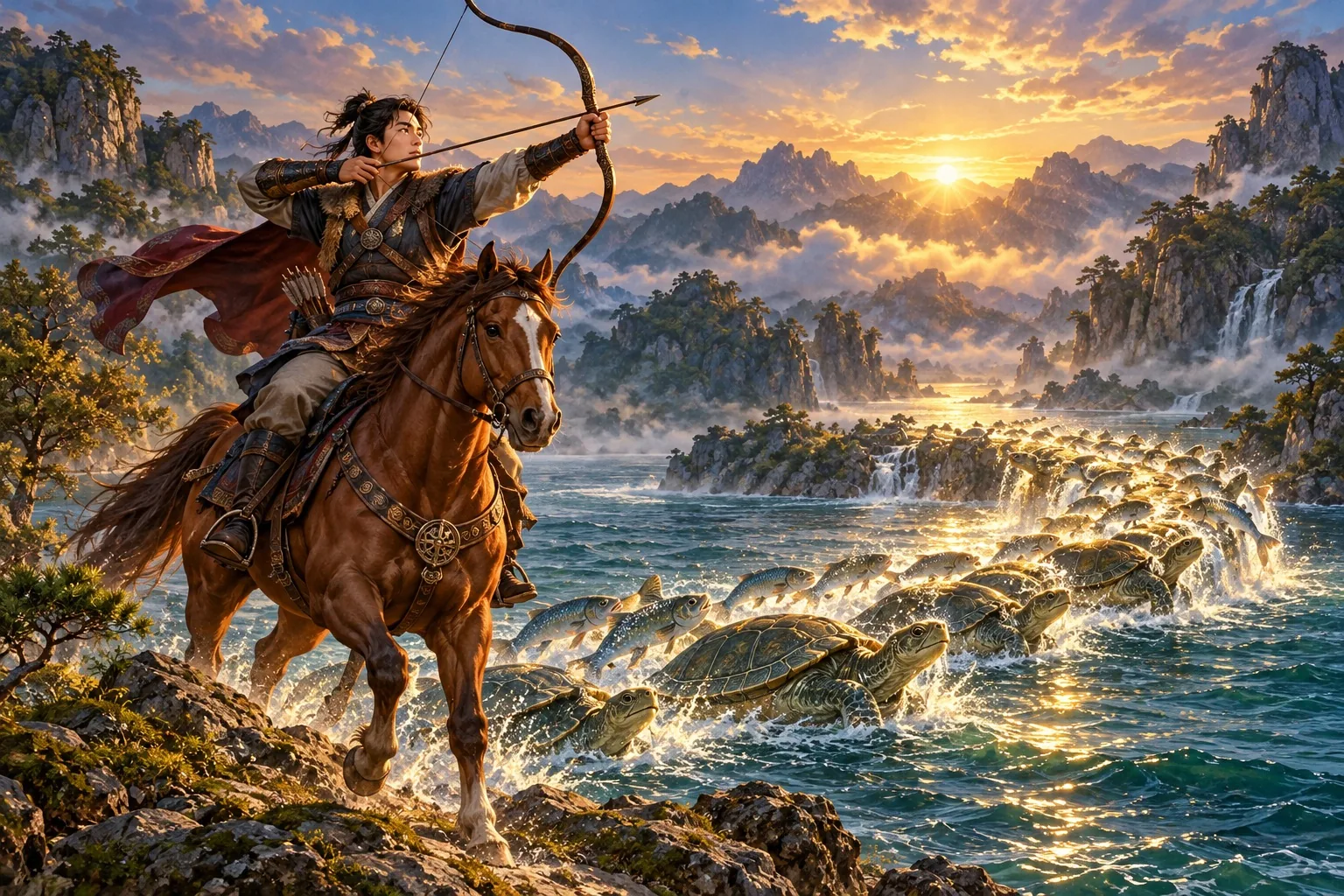
The boy grew fast and he was remarkable at everything, but most of all he could shoot. While still very small he made himself a little bow and arrows, and he never missed. In the language of Buyeo, a person who was a superb archer was called jumong, and that became his name.
People said that when he was still a tiny baby, flies bothered him as he slept, so he made himself a tiny bow and shot them out of the air one by one. Whether that was true or not, nobody in Buyeo had ever seen anything like him.
King Geumwa had seven sons of his own, and as Jumong grew, they grew jealous. He was faster than them, stronger than them, and a far better shot. When they went hunting together, Jumong brought back more game with fewer arrows than all seven princes put together. The eldest prince went to his father. “Jumong was not born like a man,” he said. “If we do not get rid of him now, he will cause us trouble.” The princes began to plot against his life.
The king did not have Jumong killed, but he set him to work looking after the royal horses. Jumong’s mother knew the danger was growing, and she helped him with a clever plan. Jumong could tell which horse in the stables was the fastest of all. He fed that horse very little, so that it grew thin and scruffy, and he fed the slow horses so well that they grew fat and glossy. When the king came to inspect the stables, he kept the handsome fat horses for himself and carelessly gave the skinny one to Jumong.
“You cannot stay here,” his mother told him. “They will kill you. Go, and do something great.”
She held his face in her hands and looked at him for a long time, as if she were trying to remember every line of it. “A man who is going to do great things must go a long way,” she said. “Don’t worry about me. Go.”
The bridge of fish
Jumong slipped away with a few loyal friends, riding south on the thin, fast horse. But the princes soon discovered he was gone, and they came after him with soldiers.
Jumong rode hard until he came to a wide river. There was no bridge and no boat, and the water ran deep and fast. Behind him he could hear hooves drumming closer and closer.
Some records call it the Eomsasu, others the Gaesasu. Its water was brown with spring floods, and it roared over the stones.
Jumong turned to the river and called out across the water. “I am the son of the Lord of Heaven,” he cried, “and the grandson of the River Lord. My enemies are almost upon me. What shall I do?”
The surface of the river began to stir. Fish rose from the depths, great shoals of them, and turtles with broad shells, crowding together side by side until they made a bridge from one bank to the other. Jumong and his companions rode across on their backs. The moment they reached the far bank, the fish and turtles sank away, and when the princes and their soldiers came galloping up to the water’s edge, there was nothing to cross on. They could only watch Jumong disappear into the south.
Jumong reined in his thin, fast horse and looked back across the river at the princes on the other side, shouting and shaking their fists. Then he turned his horse’s head to the south and did not look back again.
The kingdom of Goguryeo
Jumong travelled south until he came to a place called Jolbon. The land was good, the mountains were strong and the rivers were clear. There, with only a simple hut to begin with, he founded a new kingdom and named it Goguryeo.
He was twenty-two years old, the old histories say. His palace was a hut of reeds by the Biryu river, and his kingdom was a handful of loyal friends and a few families who had come to join him. But he had come a long way from the egg on the road.
His new country had a powerful neighbour, Biryu, ruled by King Songyang, who expected the newcomer to bow to him. Jumong would not. The two kings met to settle the matter, and Jumong beat Songyang at archery. Then, by a clever trick, he carried off Biryu’s royal drum and horn, the symbols of a king’s authority. Finally, the old poem says, he used his magic to bring down rain until the land of Biryu was flooded, and King Songyang surrendered.
From then on Goguryeo grew stronger and stronger, until it became one of the great kingdoms of the north, and its kings remembered Jumong, King Dongmyeong, as the son of heaven who founded it. The boy who was born from an egg and thrown to the dogs had become a king.
Real kingdom, real stone
Goguryeo was a real and powerful kingdom that ruled much of northern Korea and Manchuria for centuries. Its kings took their founder’s story seriously. In 414 CE, King Jangsu set up a towering stone stele for his father, King Gwanggaeto the Great, and its inscription begins with Jumong: the son of the Lord of Heaven and the daughter of the River Lord, born from an egg, who crossed a river on a bridge of turtles to found the kingdom. The stele still stands near the Yalu River today.
Talk about it
Why do you think the animals refused to harm the egg? Was Jumong’s trick with the horses fair? And why might a king want people to believe that the sky and the river themselves had helped his ancestor?
Words to know
Jumong (주몽) means “good archer” in the old language of Buyeo. Haemosu (해모수) is the son of heaven who was Jumong’s father, Habaek (하백) is the River Lord and Yuhwa (유화) is his daughter, Jumong’s mother. Buyeo (부여) was an older kingdom to the north. Goguryeo (고구려) is the kingdom Jumong founded, one of Korea’s Three Kingdoms.
Where this story comes from
Jumong, also called King Dongmyeong (동명왕), is remembered as the founder of Goguryeo, one of Korea's Three Kingdoms, traditionally in 37 BCE. His story survives in several early sources. It opens the great stone stele of King Gwanggaeto, carved in 414 CE, and it is told in the histories Samguk Sagi (1145) and Samguk Yusa (1280s). The fullest version is a long poem, Dongmyeongwang-pyeon ("The Lay of King Dongmyeong"), written in 1193 by the Goryeo writer Yi Gyu-bo, which the Encyclopedia of Korean Culture calls the best of all the sources and describes as a heroic epic.
The sources do not always agree. They differ over Jumong's family tree and over details such as who thought of the trick with the horses: in some, Jumong works it out himself, and in Yi Gyu-bo's poem it is his mother's idea. The retelling here blends the common outline the encyclopedia gives. Jumong's story is also close to the founding myth of Buyeo, the older northern kingdom he fled, whose founder Dongmyeong likewise escapes across a river on a bridge of fish and turtles.
What it means
The Encyclopedia of Korean Culture calls this the most turbulent of Korea's ancient myths. From the moment he is born, Jumong faces rejection and danger, and the story follows him through persecution, escape and struggle until he founds a kingdom. That arc, a hero who survives one trial after another, is why it is called an epic.
It is also a story about where power comes from. Jumong is the son of a sky god and the grandson of a river god, and at the river he calls on both: "I am the son of the Lord of Heaven and the grandson of the River Lord." Nature itself answers him. The encyclopedia notes that he is shown both as a warrior, a superb rider and archer, and as a kind of magician, making a 'magical escape' and later using spells to bring rain and flood. In ancient Korea, a king was expected to be both. The egg birth matters too. Several Korean founders, including Bak Hyeokgeose of Silla and Kim Suro of Gaya, are born from eggs, a sign that a ruler is a new and sacred life sent from heaven.
Sources & further reading
Retold from the outline of the Dongmyeong myth in the Encyclopedia of Korean Culture entry "동명왕신화", which combines the Samguk Sagi, the Samguk Yusa and Yi Gyu-bo's Dongmyeongwang-pyeon. It is an English adaptation, not a translation.
- Encyclopedia of Korean Culture · 동명왕신화 (the Dongmyeong myth) ↗
- Encyclopedia of Korean Culture · 난생신화 (egg-birth myths) ↗
Illustrations are imaginative interpretations, not historical records. Read our editorial policy.