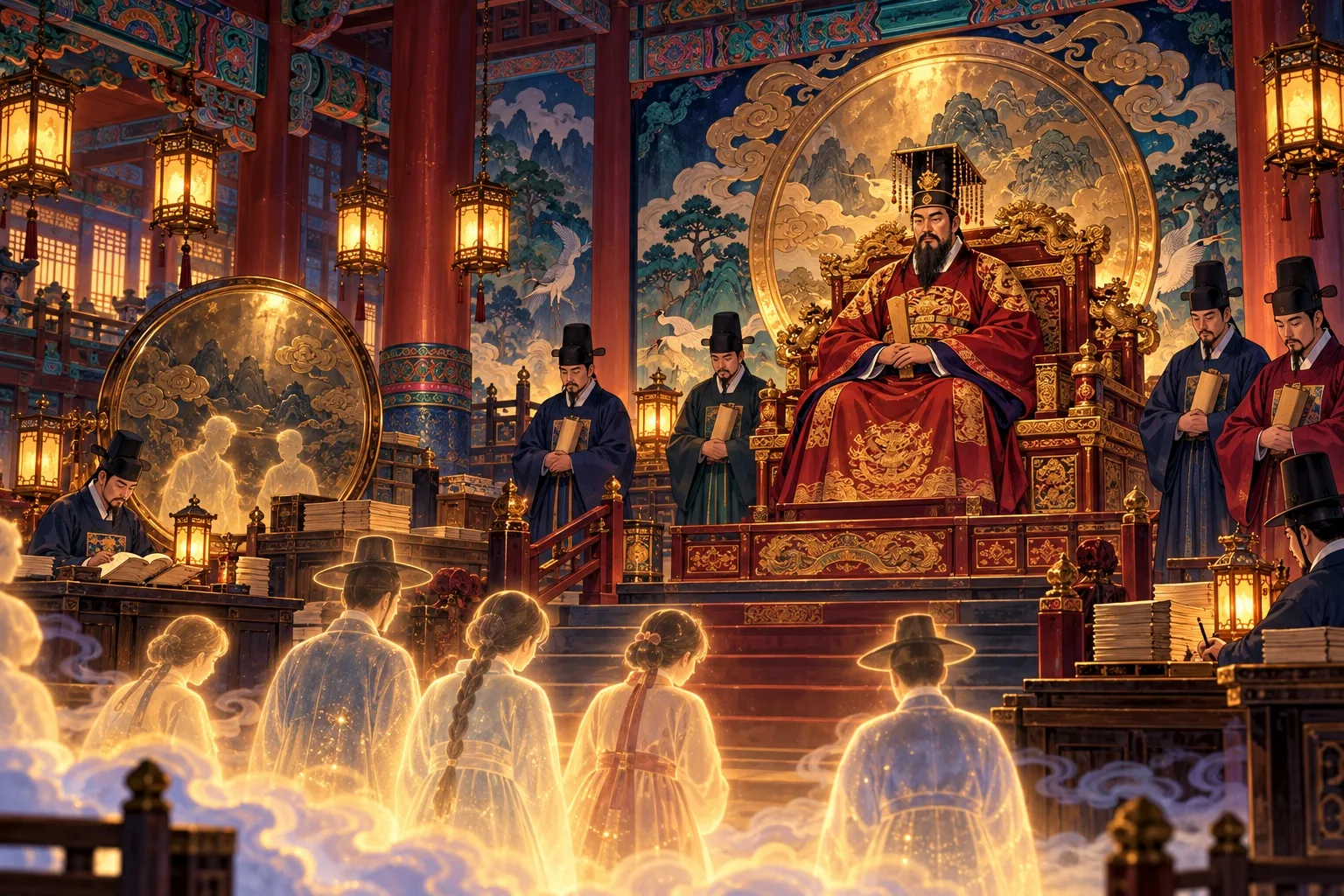
In Korean, the world of the living is iseung (이승), “this life”, and the world of the dead is jeoseung (저승), “that life”. The two words sound almost the same, and that is no accident. In traditional Korean thinking, the land of the dead is not impossibly far away. An old Korean funeral song, quoted in the Encyclopedia of Korean Culture, says it plainly: they told me the road to the underworld was long, but it lies just outside the front gate.
What waits there is a court. A Korean soul does not simply drift into heaven or fall into hell. It is arrested, brought in, questioned and judged, by a panel of ten kings. The most famous of them is Yeomra Daewang (염라대왕), King Yeomra, a name every Korean child knows.
Where the Korean underworld came from
The encyclopedia explains that Korea’s ideas of the afterlife grew from several roots at once. The oldest native belief saw the land of the dead simply as another place where the dead live, joined to this world and reached by ordinary travel. Confucian scholars borrowed the old Chinese word hwangcheon, the Yellow Springs, for the world beneath the earth. Then Buddhism and Daoism brought the idea of hells, paradise and a great bureaucracy of judgement.
The idea of the Ten Kings developed in China during the Tang dynasty and was set out in a scripture known in Korea as the Sutra of the Ten Kings. The encyclopedia says belief in the judges of the underworld reached Korea in the early Unified Silla period, and that ideas about hell were firmly established through the Goryeo dynasty.
The ten courts
The ten kings each sit in their own hall, and the soul passes before them one after another. According to the scripture the encyclopedia cites, the schedule is precise:
- on the 7th day after death, King Jingwang
- on the 14th day, King Chogang
- on the 21st day, King Songje
- on the 28th day, King Ogwan
- on the 35th day, King Yeomra
- on the 42nd day, King Byeonseong
- on the 49th day, King Taesan
- on the 100th day, King Pyeongdeung
- after one year, King Dosi
- after three years, King Odo Jeollyun
That is why the forty-ninth day after a death matters so much in Korean Buddhist tradition, and why memorial rites were held at the hundredth day and the first and third anniversaries. At each stage, the living family could help the soul with prayers and offerings while its case was still being heard.
King Yeomra, the fifth king, became by far the most famous. His name comes from Yama, the ancient Indian lord of death, and in Korean speech and story he often stands in for the whole underworld court. In late Joseon temples, he was sometimes even painted on his own, in a special kind of Buddhist painting.
Arrest, gates and paperwork
How does a soul get to court? The encyclopedia draws on a Joseon Buddhist song, the Byeol hoesimgok, which describes the process step by step. The Ten Kings send out two messengers, the Messenger of the Day and the Messenger of the Month. They come to the dying person’s house, call out the person’s name three times, bind them in iron chains and lead them away. And the underworld is right there, just outside the gate.
At the outer gate stand guards with the heads of oxen and horses. Beyond twelve great gates wait demon officers with fish heads and goblin faces, holding banners, spears and instruments of punishment. The Ten Kings take their seats, and Choe Pangwan, Judge Choe, holds the records. Each man and woman is brought in to be questioned, and the question is always the same: what good did you do in the world of the living?
The encyclopedia notes how much this underworld looks like a Joseon government office, with its officials, documents, interrogations and sentences. The first king weighs a soul’s good and evil deeds and decides whether it may go straight to paradise or must pass on through the courts. Souls who have finished their punishment are reborn, and good people may return as humans.
Meet the jeoseung saja, the messengers who collect the dead →
The Hall of the Underworld
Visit almost any large Korean temple and you can see the Ten Kings for yourself. The encyclopedia notes that halls called Myeongbujeon (Hall of the Underworld) or Siwangjeon (Hall of the Ten Kings) became almost standard. Inside, statues of the ten kings sit in rows on either side of Jijang Bosal, the bodhisattva Ksitigarbha, who vowed to save every soul from hell. Paintings of the Ten Kings follow an almost fixed design: in the upper half, a king sits behind his desk judging the dead, and in the lower half, sinners suffer the punishments of hell. Famous examples hang at Haeinsa (1742) and Okcheonsa (1744).
Not everyone approved. In 1913, the monk and poet Han Yong-un argued that the Ten Kings were not truly Buddhist at all but folk belief, and called for these halls to be abolished. The halls stayed. The encyclopedia concludes that, whatever its doctrinal standing, belief in the Ten Kings was deeply persuasive and became part of Korean Buddhist culture.
People who came back
Korean storytellers loved tales of the underworld, and the encyclopedia sorts them into two main kinds. In the first, someone is taken to the underworld and returns to life. In the second, a person of great talent dies and becomes an official there, even King Yeomra himself.
The return stories begin early. The Samguk Yusa tells of the monk Seonyul, who came back from death. In a famous Joseon tale, a man who has died of fever travels through the hells and reaches King Yeomra, only to discover that he was brought in by mistake, and is sent home. In a well-known oral legend behind the saying “live in Jincheon, die in Yongin”, a man from Jincheon dies suddenly and goes before King Yeomra, but by the time he is sent back his body has already been buried, so he returns to life in the body of a man from Yongin.
The second kind of story honoured real people. Respected officials and scholars were said to have been summoned after death to serve as judges or as King Yeomra. In one folktale a son meets his father, who has become King Yeomra. In another, a poor man meets an old friend who has become the king of the underworld and is given money that makes him rich. And many stories turn on the old trick of the messengers’ mistakes, such as two people with the same name, which gives a lucky soul a second chance. One of the most popular is about Dongbangsak, who was destined to die young but charmed the underworld messengers and lived for an astonishing three thousand cycles of sixty years.
The encyclopedia points out something lovely about all these stories. For all their talk of judgement and punishment, what they really care about is life. Their happy ending is rarely paradise. It is going home, and getting more years in the world of the living, and using them well.
Quick facts
Jeoseung is the Korean world of the dead, imagined as close by, “just outside the gate”. Under Buddhist and Daoist influence it became a court of ten kings who judge each soul in turn, from the 7th day after death to the third year, with King Yeomra as the fifth and most famous judge. Messengers arrest the dead, Judge Choe keeps the records, and souls are judged by their good deeds. Korean temples have halls for the Ten Kings, and Korean folktales are full of people who came back.
Read the story of Princess Bari, who walked through the underworld →