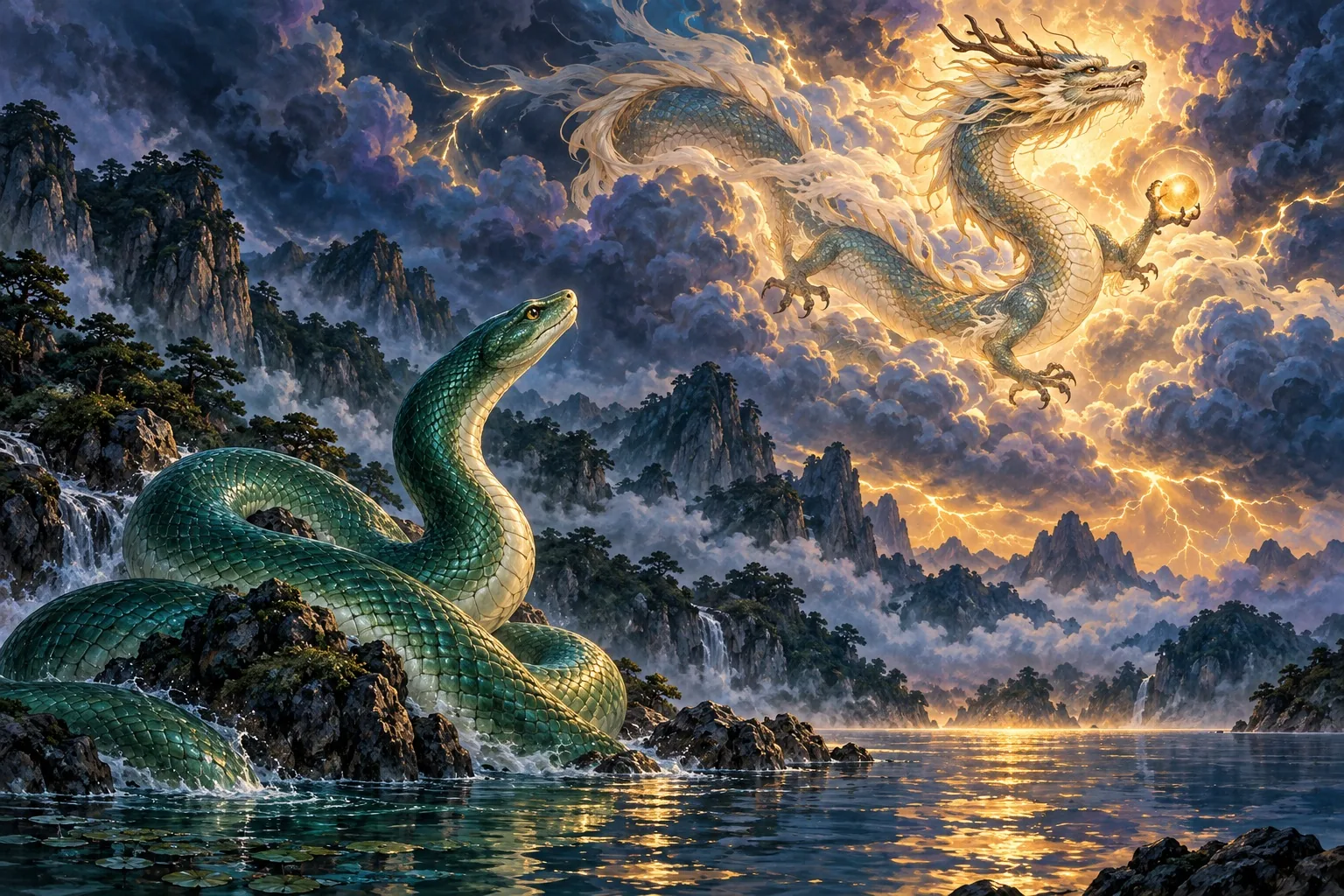
In Korean tradition, dragons are not born. They are made, slowly, over a very long time. A great serpent lives at the bottom of a deep pool or river for a thousand years, waiting for its moment. If it succeeds, it rises into the sky in a storm of cloud and rain and becomes a yong (용), a dragon. If it fails, it remains an imugi (이무기), a huge, frustrated serpent that never quite made it. This idea, that a dragon is a creature that has to earn its place in heaven, gives Korean dragon stories their particular feeling of struggle and hope.
Yong, mireu and imugi
The usual Korean word for dragon is yong, from the Chinese character 龍. But Korean also had an older, native word. A sixteenth-century character primer, the Hunmong jahoe, glosses 龍 as mireu, and the Encyclopedia of Korean Culture links that word to the old Korean word for water. Even in its name, the Korean dragon was a creature of water.
The imugi is the dragon that hasn’t happened yet. The encyclopedia describes it as a special snake with great power that is trying to become a dragon, usually imagined as an enormous serpent living in deep water. In some regions it is called isimi. Folk belief held that an imugi which endured for a thousand years could become a dragon and ascend to the sky. There were also serpents that came close and fell short, called gwangcheori, which could fly but caused droughts instead of rain.
The magic pearl
What does an imugi need to become a dragon? In East Asian tradition the answer is the yeouiju (여의주), the wish-fulfilling jewel. Dragons in Korean painting are almost always shown chasing or clutching a glowing pearl among the clouds, and the encyclopedia explains that a dragon needs this jewel in order to rise to heaven. Its meaning grew over time, and under Buddhist influence it became the jewel that grants every wish.
This gave storytellers a powerful image. An imugi without the pearl is stuck, however strong it is. Many Korean legends tell of serpents that waited a thousand years, only to be spotted by a passing human at the very moment of their ascent, and so fell back to earth. The idea that being seen at the wrong moment could ruin a transformation runs through Korean folklore, and you’ll find it in other creatures’ stories too.
Lords of rain and the sea
Above all, Korean dragons were water gods. They gathered the clouds and sent down the rain, which made them enormously important in a farming country. When drought struck, people turned to the dragons. The Samguk Sagi records that the Silla king Jinpyeong ordered dragons to be painted to call for rain, and later royal records of the Goryeo and Joseon dynasties describe rain rituals in which clay dragons were made and offered prayers. In villages, people prayed at dragon pools and wells, and on the fifteenth day of the sixth lunar month families held rites for the dragon god of water.
Along the coast, the dragon became the Yongwang (용왕), the Dragon King, ruler of the sea, who could grant a good catch or send storms. Fishing communities still hold rituals for him. The Dragon King is also the ruler of the undersea palace in one of Korea’s most famous tales.
Read The Rabbit and the Dragon King →
The dragon who guarded Korea
The most moving Korean dragon story is about a king. Munmu, the seventh-century ruler who completed the unification of the Korean peninsula under Silla, is said in the Samguk Yusa to have asked to be buried at sea so that he could become a great dragon and protect his country from invaders. An underwater tomb off the coast near Gyeongju is traditionally identified as his resting place, and the Samguk Yusa goes on to tell how the dragon-king and a heavenly spirit later sent a magical bamboo flute, the Manpasikjeok, which could calm waves and drive away enemies when played.
The Samguk Yusa is full of dragons. Master Jajang is said to have driven nine dragons out of the pond where Tongdosa temple was built. A dragon guarded the great nine-storey pagoda of Hwangnyongsa, the “Yellow Dragon Temple”, in Gyeongju. And the official history of the Goryeo dynasty tells how its founder’s grandfather met the Dragon King of the West Sea and married his daughter, giving the royal family a dragon in its ancestry.
The dragon and the king
Because the dragon was the mightiest of all creatures, it became the symbol of royal power. Korean kings wore the yongpo, a red or blue robe embroidered with five-clawed dragons. The king’s face was called the “dragon face”, his throne the “dragon seat” and even his tears “dragon tears”. When the early Joseon court composed the epic Songs of the Dragons Flying to Heaven (Yongbieocheonga) in 1445, it described the dynasty’s founder and his ancestors as six dragons rising from the eastern land.
The encyclopedia notes that the Munheon bigo, a Joseon reference work, records twenty-nine sightings of dragons between the Silla period and 1714, each taken as a sign of great events: a prosperous reign, the birth of a great person, or the death of a king.
Dragon dreams and dragon places
Even today, a dragon dream is the luckiest dream a Korean can have. To dream of a dragon is said to foretell great success, and in folklore it often announces the birth of a remarkable child. A Korean idiom for making it big, deungyongmun, literally means “climbing the dragon gate”, after the legend of a carp that leaps up a waterfall and turns into a dragon.
Dragons also left their mark on the map. All over Korea you’ll find places called yongso (dragon pool), yongyeon (dragon pond) and yongjeong (dragon well), many with a legend of a dragon that lived or rose there. The mountain Gyeryongsan, “Rooster-Dragon Mountain”, near Daejeon, is one famous example.
Korean dragons and other dragons
Korean dragons share most of their features with Chinese dragons: long serpentine bodies, scales, whiskers, antler-like horns, clawed feet, and a love of clouds and water. The Korean idea of the imugi, the serpent that must wait and struggle to become a dragon, is a distinctive and much-loved part of the tradition. Unlike the fire-breathing, treasure-hoarding dragons of European legend, Korean dragons are generally wise, powerful and good. They bring rain and protect kingdoms, and an imugi’s dearest wish is simply to rise.
Quick facts
Yong is the Korean word for dragon, and mireu is the old native word. An imugi is a great serpent that, according to folk belief, can become a dragon after a thousand years, if it holds the wish-fulfilling pearl, the yeouiju. Korean dragons control rain and the sea, which made them central to rain rituals and fishing rites. The dragon was the symbol of the king, and King Munmu of Silla is said to have become a sea dragon to protect his country.