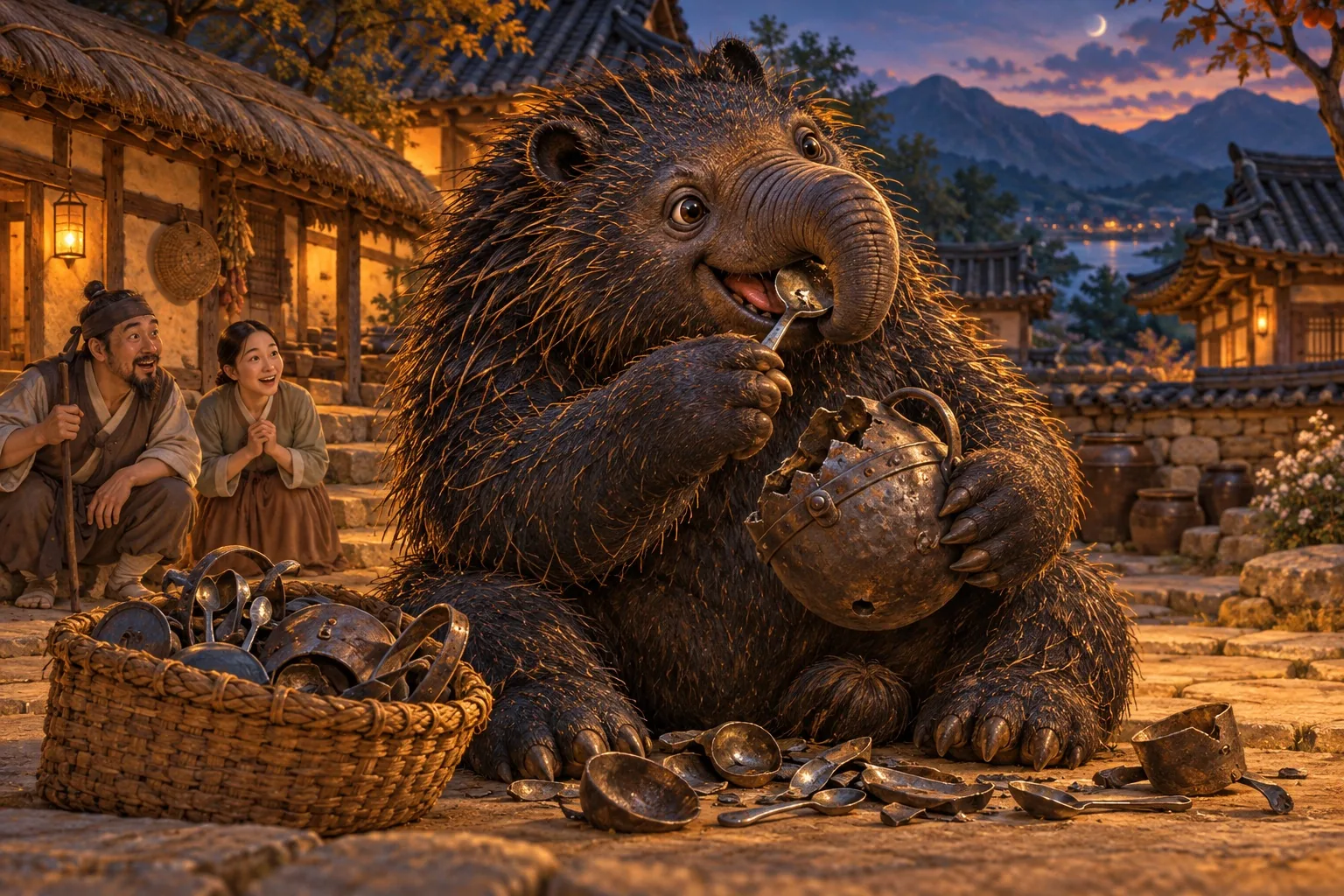
Most Korean folklore monsters are tricksters, ghosts or shapeshifters. The bulgasari (불가사리) is something rarer: a true giant monster, the kind that tramples through a kingdom while soldiers fire arrows that bounce off its hide. It eats iron, and only iron. It grows bigger with every needle, nail and cooking pot it swallows. And as its name warns, it cannot be killed.
“Impossible to kill”
The name bulgasari is usually written with the characters 不可殺, “cannot be killed”, followed by a suffix. The Encyclopedia of Korean Culture explains that its unkillable power comes from what it eats. Iron is what weapons are made of, so a beast that devours iron can’t be harmed by swords, spears or arrows.
The earliest written account comes from the Songnam japji, a nineteenth-century Korean miscellany. It records a story passed around among ordinary people: at the very end of the Goryeo dynasty, a monster appeared in the capital, Songdo (today’s Kaesong), and ate nearly all the iron there was. People tried to kill it and failed, and so they called it “bulgasal”, unkillable. When they threw it into a fire, it turned into a ball of flame and flew into people’s houses, and those burned down too.
Oral tellings gave the name a second meaning as well. Some storytellers explained it as hwagasari, written 火可殺, meaning “can be killed by fire”, because in their version fire is exactly what finally destroys it.
The story of the bulgasari
The best-known version of the legend is set in the troubled last years of Goryeo, and the National Folk Museum of Korea’s encyclopedia gives its outline.
One day an order went out that all Buddhist monks in the land were to be arrested, and the monks fled their temples. One of them went to his younger sister’s house and begged her to hide him. She pretended to agree and locked him in a wall cupboard. Then she went to her husband with a plan: they would hand her brother over to the authorities and collect a big reward. Her husband was so disgusted that she would sell her own brother that he killed her and set the monk free.
While he was shut in the dark cupboard, though, the monk had passed the time by squeezing a few grains of cooked rice into the shape of a strange little animal. For fun, he fed it a sewing needle. To his astonishment, the tiny creature swallowed it, and grew. It ate another needle, and another, and when there was no more iron left in the house, it wandered out and began eating every piece of metal it could find: nails, hinges, spoons, pots, ploughshares, swords. With every mouthful it grew larger.
The government sent out men to capture it. They shot arrows at it and struck it with swords, and nothing worked. At last they tried to melt it with fire. But the bulgasari, full of iron, simply glowed red-hot, and as it rampaged through the streets, setting everything alight, the city burned.
Variations
In some tellings, the monster is never destroyed, and its rampage becomes a sign that the Goryeo dynasty is doomed. In others, a famous monk finally defeats it. The method, the encyclopedia says, is almost always the same: lure the bulgasari with iron, then light its tail with a flint. There is a tremendous boom, and the giant beast shrinks back into a lump of blackened rice.
The reason the monks are being hunted also changes. In some versions, the order comes after the scandals of Sin Don, a powerful monk who dominated the Goryeo court in the fourteenth century. In others, the persecution is part of the new Joseon dynasty’s policy of promoting Confucianism and suppressing Buddhism, and the bulgasari becomes a monster deliberately created by a holy monk to protest against an unjust state. The encyclopedia also mentions versions where the monk makes the creature to repay the brother-in-law who saved his life. Different storytellers used the bulgasari to say very different things: about greed, about religion, and about kingdoms rising and falling.
What does the bulgasari look like? There is no single answer. Korean tales describe it in many forms: a pig, an ant, a rat, a horse or a kind of insect. Folk art often shows it as a bear-like beast with an elephant’s trunk, a rhinoceros’s eyes, an ox’s tail and fur like needles. That composite image may owe something to a creature in Chinese tradition that was also said to eat iron.
A monster that protects
The strangest thing about the bulgasari is that a monster who burned down a capital became a protector. In Korean folk belief, the encyclopedia notes, the bulgasari was thought to ward off disaster and fire, and it was painted on folding screens and on chimneys. One famous example survives at Gyeongbokgung Palace in Seoul: the decorated brick chimney of Jagyeongjeon, the residence built for a queen dowager, carries an image of the bulgasari among its symbols of good fortune.
The logic is old and simple. A creature that cannot be killed, and that devours the iron of weapons, makes a powerful guardian against war, misfortune and evil spirits.
Where the story came from
Scholars have traced the bulgasari legend to an old Buddhist parable, the story of the Hwamo, “mother of disaster”, in a collection of Buddhist parables translated into Chinese. In that tale, a small creature eats iron, grows into an unstoppable monster and brings ruin on a kingdom. The story travelled to China and Japan as well as Korea, and each country developed its own version. In Japan, a version recorded in Nara tells of a couple’s vengeful spirits turning into an insect that eats iron and grows into a monster. The Korean version is unusual in rooting its disaster in a family betrayal: a sister ready to sell her brother for money.
The bulgasari on screen
The bulgasari has had a remarkable modern life. A printed novel, Songdo malnyeon bulgasari-jeon (“The Bulgasari of Songdo’s Last Days”), was published in 1921. A South Korean film appeared in 1962, a comic in 1971 and a children’s book in 1998. The most famous adaptation is Pulgasari (1985), a North Korean monster film directed by Shin Sang-ok, a South Korean director who had been abducted to the North. The tvN drama Bulgasal: Immortal Souls (2021–2022) took its title from the same legend. The idea of a creature that cannot die and grows stronger with every weapon thrown at it has proved irresistible to storytellers.
Quick facts
The bulgasari is a Korean iron-eating monster whose name means “impossible to kill”. In the best-known legend, a monk hiding at the end of the Goryeo dynasty shapes it from rice and feeds it a needle, and it grows until it eats the kingdom’s iron and sets the capital ablaze. It is usually destroyed, if at all, by fire. In folk belief it became a guardian against fire and disaster, and appears on the chimney of Jagyeongjeon at Gyeongbokgung Palace.
Meet the haetae, another guardian of Gyeongbokgung →